
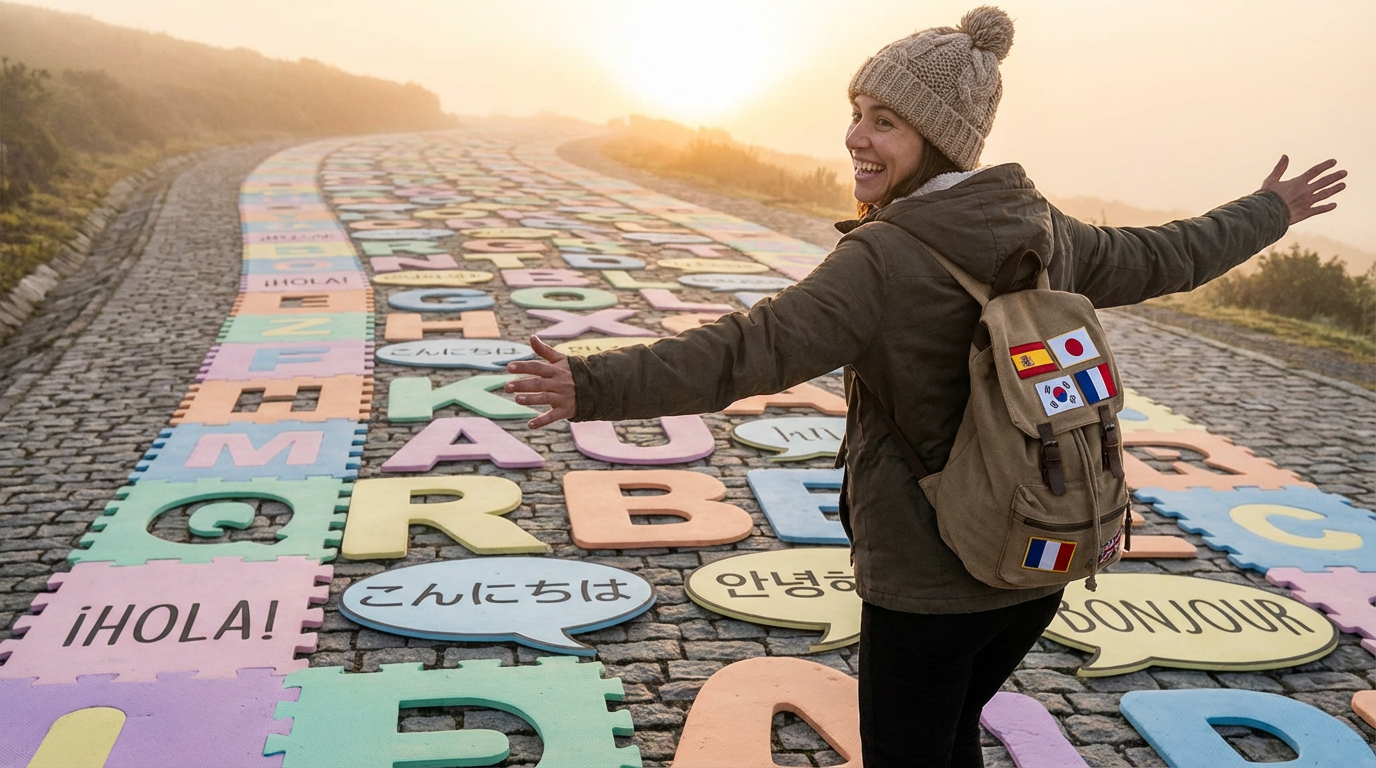
So you want to learn a new language — and you want to do it fast. Maybe you have a trip coming up, a career opportunity, or you just fell in love with a culture and want to connect more deeply. Whatever the reason, the good news is: learning a language quickly is absolutely possible. The bad news? Most popular advice gets it completely wrong.
This guide strips away the myths and gives you the actual science of rapid language acquisition — what works, what doesn't, and exactly how to structure your time.
![blog-EN[EN-021]-How to Learn a Language Fast 1.png](/upload/blog-EN%5BEN-021%5D-How%20to%20Learn%20a%20Language%20Fast%201.png)
Why Most "Fast" Language Learning Fails
Before we get into what works, let's talk about what doesn't.
The Grammar-First Trap
Studying grammar rules before speaking is like reading a swimming manual before jumping in the pool. You'll understand the theory but sink the moment you try to use it. Grammar is best absorbed through context, not memorized upfront.
The Vocabulary List Death March
Drilling 50 random words a day sounds productive. But isolated vocabulary without context evaporates within 48 hours. Research by linguist Paul Nation shows that you need to encounter a word 10–16 times in meaningful context to truly "know" it.
The "I'm Not Ready Yet" Excuse
Many learners delay speaking until they feel "ready." That day never comes. Fluency is built through output — messy, imperfect, real output. The faster you start speaking, the faster your brain wires the language in.
The Science Behind Rapid Language Acquisition
1. The Input Hypothesis (Stephen Krashen)
Linguist Stephen Krashen's landmark research shows that we acquire language primarily through comprehensible input — content that is slightly above your current level (what he calls "i+1").
In practice: watch videos, listen to podcasts, and read content you understand about 70-80% of. Your brain fills in the gaps through context. This is exactly how babies learn their first language — and it works just as well for adults.
Action step: Find YouTube channels, podcasts, or Netflix shows in your target language. Don't aim for 100% understanding. Aim for "mostly getting it."
2. Spaced Repetition Systems (SRS)
Memory researcher Hermann Ebbinghaus discovered the "forgetting curve" — we forget about 50% of new information within an hour, and 90% within a week, unless we review strategically.
Spaced repetition software (SRS) like Anki schedules reviews at the exact moment you're about to forget, making long-term retention dramatically more efficient. Studies show SRS learners retain vocabulary 2–5x better than those using traditional review.
![blog-EN[EN-021]-How to Learn a Language Fast 2.png](/upload/blog-EN%5BEN-021%5D-How%20to%20Learn%20a%20Language%20Fast%202.png)
Action step: Use Anki or a similar SRS app. Add 10–20 new words per day in context (full sentences, not isolated words). Be consistent — 15 minutes daily beats 2 hours on weekends.
3. The Output Imperative
Input builds comprehension. Output builds fluency. These are different skills and you need both.
Psycholinguist Merrill Swain's "Output Hypothesis" argues that when you try to produce language (speak or write), you discover gaps in your knowledge that input alone never reveals. Struggling to say something forces your brain to problem-solve — and that struggle is where real learning happens.
Action step: Speak from Day 1. Use simple sentence frames:
"I want to..."
"Can you help me with...?"
"I don't understand, can you say that again?"
You don't need complex grammar to have a real conversation.
4. Emotional Engagement and the "Affective Filter"
Krashen also identified the "Affective Filter" — anxiety and low motivation create a psychological barrier that blocks input from reaching your long-term memory. Relaxed, curious, motivated learners absorb language far faster.
This is why learning through things you genuinely love — music, cooking, sports, K-dramas — accelerates acquisition. Your emotional investment lowers the filter.
Action step: Find your "motivational anchor" — a TV show, a musician, a community, a place you want to visit. When you're learning for something that excites you, studying doesn't feel like studying.
The Fast-Track Learning System: Your Daily Blueprint
Here's how to structure your time for maximum speed. This is based on the "total immersion lite" approach used by polyglots like Benny Lewis and Olly Richards.
Phase 1: Foundation (Weeks 1–2) — 1 hour/day
Goal: By end of Week 2, you can introduce yourself, count, name common objects, and ask simple questions.
Phase 2: Building (Weeks 3–8) — 1–1.5 hours/day
Goal: By end of Week 8, you can navigate everyday situations — ordering food, asking directions, chatting about yourself and your interests.
Phase 3: Expansion (Weeks 9–24) — 1.5–2 hours/day
Goal: By Month 6, comfortable conversational fluency in most everyday topics.
5 Speed Hacks That Actually Work
Hack #1: Learn Cognates First
If you speak English, Spanish, French, and Italian share thousands of cognates — words that look and sound similar to English. Spanish alone has 5,000+ cognates with English (information → información, hospital → hospital, important → importante). Start with these for instant vocabulary wins.
Hack #2: Use the "Goldilocks Zone" for Input
Beginner content is too easy (boring). Native-level content is too hard (overwhelming). The "Goldilocks Zone" is content that's slightly challenging — you understand about 70–80%. This is where acquisition happens fastest.
Hack #3: Talk to Yourself
Narrate your day in your target language. "I'm making coffee. The coffee smells good. I need to go to the store later." This practice — called self-talk — builds fluency without needing a conversation partner. It's weird but it works.
Hack #4: Set a "Minimum Viable Practice" Rule
Some days life gets busy. Instead of skipping entirely, set a 5-minute minimum. Open your SRS app on the bus. Record a 2-sentence voice memo in your target language. The habit of daily contact — even tiny — is more important than any single long session.
Hack #5: Use AI Conversation Tools
Traditional language exchange requires scheduling and patience. AI conversation partners like TalkMe let you practice speaking in any language, at any time, with instant corrective feedback. You can practice ordering food at 2am, rehearse a job interview scenario, or just chat about your day — all without judgment.
![blog-EN[EN-021]-How to Learn a Language Fast 3.png](/upload/blog-EN%5BEN-021%5D-How%20to%20Learn%20a%20Language%20Fast%203.png)
The Honest Timeline: How Fast Is "Fast"?
Let's set realistic expectations based on research from the Foreign Service Institute (FSI), which trains US diplomats in foreign languages:
"Full-time" means 8 hours per day. For most people studying 1–2 hours daily:
Category I languages: 12–18 months to solid conversational fluency
Category IV languages: 3–5 years
But "fluency" is a spectrum. You can reach useful conversational ability in Category I languages in 3–4 months of focused daily practice. That's what "fast" realistically looks like.
The #1 Mistake That Kills Progress
Switching methods constantly.
Language learning has an enormous industry built around selling new methods, apps, and courses. New learners often try one thing, get impatient after a few weeks, and jump to the next shiny solution.
The research is clear: consistency over time with any solid method beats hopping between "perfect" methods.
Pick a system. Commit for 90 days. Adjust based on your specific gaps — but don't abandon the whole approach because progress feels slow. Language learning is non-linear. You'll plateau, then suddenly jump.
Tools That Support Fast Learning
Here's a curated toolkit:
Vocabulary & Memory
Anki — free, customizable spaced repetition (best for serious learners)
Clozemaster — vocabulary in context through fill-in-the-blank challenges
Listening & Input
Language Transfer — free audio courses for beginners (Spanish, Italian, French, more)
Language Reactor (Chrome Extension) — dual subtitles on Netflix for immersive listening
Speaking & Output
TalkMe — AI conversation partner for speaking practice anytime, any language. Great for low-stakes daily speaking habit. Visit talkme.ai or read more on blog.talkme.ai
iTalki — connect with human tutors for structured lessons
Grammar Reference
Duolingo — gamified basics, good for building a habit
Grammatically structured YouTube channels for your target language
FAQ: Fast Language Learning
Q: Can I really become fluent in 3 months?
A: "Fluent" depends on what you mean. Basic conversational ability in an easy language (Spanish, Italian) in 3 months of full-time study? Yes. Full professional fluency? No. Be honest about what "fast" means for your goals.
Q: What's the single most important thing to do every day?
A: Speak. Even 10 minutes of active speaking practice beats 2 hours of passive watching. Your mouth needs to learn the language, not just your ears.
Q: Do I need a native speaker to practice with?
A: It helps, but it's not required — especially early on. AI conversation tools (like TalkMe) give you unlimited low-pressure practice. Once you have basic fluency, adding native speakers accelerates you further.
Q: Is it true some people are "bad at languages"?
A: No. Research consistently shows that aptitude differences between adults are small. The biggest predictors of success are time invested and emotional motivation — not innate talent.
Q: What if I forget everything after a trip?
A: That's called "forgetting curve regression" — totally normal. But the second time you learn it, it comes back much faster. Language knowledge doesn't truly disappear; it just needs reactivation. 10 minutes of SRS review per day maintains what you've built.
Q: Should I learn multiple languages at once?
A: Generally no, unless one is already strong. Cognitive interference between similar languages (Spanish + Italian) can slow both down. Master one to B1 level before starting another.
Your 30-Day Fast-Start Challenge
Here's a simple, concrete 30-day plan to build unstoppable momentum:
Days 1–7: Sound Foundation
Learn the phonetic system of your target language (all the sounds it uses)
Learn the 100 most common words using SRS
Listen to 15 minutes of beginner audio every day
Days 8–14: Sentence Activation
Build 20 core sentence frames (greetings, needs, opinions)
Have your first 5-minute conversation — with an AI tutor if needed
Add 10 new words to SRS daily
Days 15–21: Content Immersion
Find your "motivational anchor" content (show, podcast, music)
Aim for 30 minutes of comprehensible input daily
Journal 3–5 sentences in your target language
Days 22–30: Real-World Testing
Have a conversation with a native speaker (online or in-person)
Order something, ask for directions, or navigate a real-world scenario
Celebrate your wins — you've built a language learning habit!
Final Thought: Speed Is a Byproduct
Here's the counter-intuitive truth about learning a language fast: the fastest learners aren't trying to rush. They're deeply engaged. They find the language genuinely fascinating. They practice every day not because they force themselves to, but because they want to.
Speed is a byproduct of joy, consistency, and the right methods.
Start today. Not tomorrow — today. Even five minutes. Open an SRS app, find a video in your target language, or say "hello" to an AI conversation partner. Every fluent speaker started exactly where you are right now.
Want to accelerate your speaking practice with AI conversation? Try TalkMe — your always-available language partner that corrects, guides, and motivates you to speak more every day.
Explore more language learning guides at blog.talkme.ai


Comments
No comments yet.
Leave a Comment