
If you've ever found yourself screaming "진짜!" at your screen during a live stream or whispering "아이야" when your bias does something adorable — congratulations, you're already learning Korean through K-pop. But there's a whole vocabulary out there that separates casual listeners from true fans who can follow variety shows, understand fan wars, and chat confidently in online K-pop communities.
This guide covers 10 essential Korean phrases every K-pop fan needs. Whether you're watching music shows, scrolling through Twitter fan accounts, or planning your first trip to a K-pop concert in Seoul, these expressions will take you from passive listener to active participant in global K-pop culture.
Why K-pop Is the Perfect Gateway to Korean
Before diving into specific phrases, let's talk about why K-pop is arguably the best language learning tool for Korean:
Massive input volume. The average dedicated K-pop fan consumes hours of Korean content daily — music videos, dance tutorials, variety shows, vlogs, and live streams. That's far more exposure than any textbook provides.
Emotional encoding. When you learn a phrase because your favorite idol said it and made you laugh or cry, that emotional connection cements the vocabulary in your memory far more effectively than rote memorization.
Cultural context built in. K-pop doesn't just teach you words — it teaches you why those words matter. The concept of "울른다" (sul-leun-da, acting cute) only makes sense when you understand the idol training system that created it.
Real-time, authentic language. K-pop content is current. You're learning slang, internet speak, and casual expressions as they're actually used by young Korean people right now, not outdated textbook Korean.
For structured practice, tools like TalkMe (talkme.ai) let you practice these K-pop phrases in real conversations with AI, so you can use them naturally when you actually meet fellow fans or travel to Korea.
The 10 Essential Korean Phrases for K-pop Fans
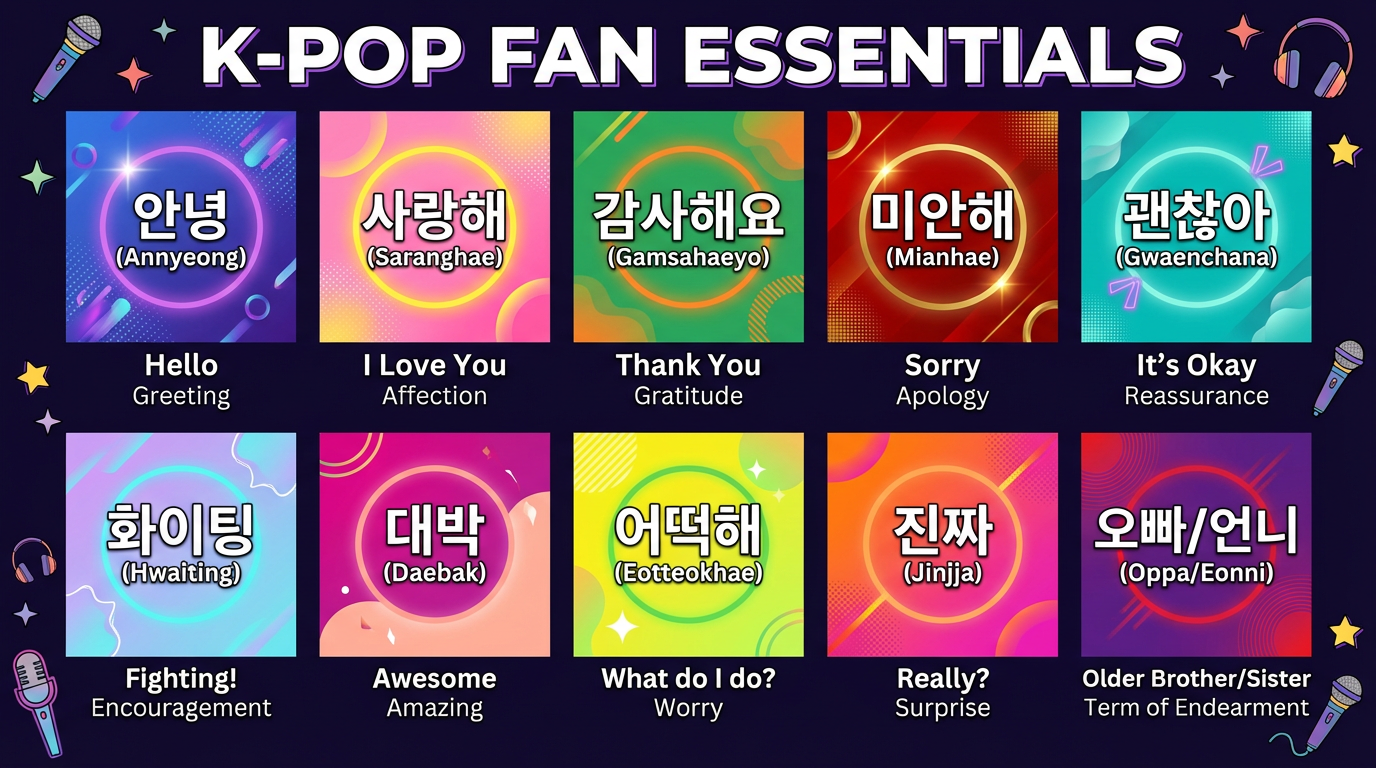
1. 사랑해요 (Saranghaeyo) — "I Love You"
What it means: The standard "I love you" in Korean. The most recognizable phrase in K-pop.
How K-pop uses it: This is the phrase fans scream at concerts, write in fan letters, and use in every comment section. The idol response? Usually "나도 사랑해요" (Nado saranghaeyo, "I love you too") — which you might hear at fan meetings.
Usage example:
Fan: 사랑해요! 진짜 사랑해요! (Saranghaeyo! Jinjae saranghaeyo!)
I love you! I really love you!
Related expressions:
좋아해요 (Johahaeyo) — "I like you" (softer, safer for casual use)
최애 (Chae) — "bias" / "favorite" (fan slang)
2. 화이팅 (Hwaiting) — "Fighting!" / "You Can Do It!"
What it means: The Korean equivalent of "good luck" or "you can do it!" — used as encouragement.
How K-pop uses it: You'll hear this at every competition, every concert opener, and in virtually every vlog where an idol is about to do something challenging. It comes from the English word "fighting" (as in, "fighting spirit"), and it's the single most useful phrase for sounding like a real K-pop fan.
Usage example:
Fan: 내일 콘서트 화이팅! (Naeil konsiteo hwaiting!)
Fighting for tomorrow's concert! (Good luck / Go for it!)
Cultural note: The spelling varies — you'll also see 화이팅 (hwaiting), 파이팅 (paiting), and even the English "fighting!" in Korean internet culture. All are correct.
3. 귀여워 (Gwiyeowo) — "Cute" / "Adorable"
What it means: The go-to word for describing something or someone as cute, adorable, or endearing.
How K-pop uses it: When your bias does something adorable on variety show, 귀여워 is the only appropriate response. The more emphatic form is 귀여워 죽겠다 (Gwiyeowo juggetda) — "so cute I could die."
Usage example:
Fan comment: 오늘 민윤기의 댄스 귀여워 죽겠다 💜 (Oneul Min-Yung-gi-ui daenseu gwiyeowo juggetda)
Today's Min Yoongi dance is so cute I could die
Related expressions:
얼짱 (Eoljjang) — "face-cute" (someone who is gorgeous)
몸짱 (Momjjang) — "body-cute" (someone with a great figure)
발연기 (Bal-yeongi) — "acting with your body" (expressive acting)
4. 아이돌 (Aidol) — "Idol"
What it means: Directly from the English word "idol" — refers to a K-pop star or group member.
How K-pop uses it: This is the foundation of all K-pop vocabulary. The idol industry in Korea (아이돌 산업) is a massive cultural phenomenon, and understanding this term is your first step into deeper K-pop culture.
Usage example:
Fan: 오늘 새로운 아이돌 그룹 보았다! (Oneul saeroun Aidol geurup boasseo!)
I saw a new idol group today!
Idol-related vocabulary:
연습생 (Yeonseup-saeng) — trainee
데뷔 (Debyu) — debut
컴백 (Keombaek) — comeback (new release)
팬미팅 (Paen-miting) — fan meeting
5. Bias / Bias Wrecker (바이어스 / 바이어스 렉커)
What it means: Your bias (바이어스) is your favorite member of a group. A bias wrecker (바이어스 렉커) is the member who keeps threatening to steal that top spot.
How K-pop uses it: Every conversation in K-pop fandom eventually turns to bias discussions. This vocabulary is essential for online fan communities, Discord servers, and Twitter spaces.
Usage example:
Fan: My BTS bias is V, but J-Hope is such a bias wrecker.
BTS의 바이어스는 뷔인데, 제이홉이 바이어스 렉커야.
Fan role vocabulary:
덕질 (Deok-jil) — dedicated fan activity (obsessive love)
덕후 (Deokhu) — a dedicated fan
控評 (Hangul:kong-pyeong) — controlling comments (fan org behavior)
6. 좋아하는 (Joh-ahaneun) / 최애 (Choe-ae) — "Favorite"
What it means: These are the two most common ways to say "favorite" in K-pop fan contexts.
How K-pop uses it: 좋아하는 is the standard word ("the one I like"). 최애 is fan slang borrowed from Japanese fan culture — it means "ultimate favorite" and carries more emotional weight.
Usage example:
Fan: Stray Kids의 최애는 한전자이야. (Stray Kids-ui coeae-nun hanjeonja-i-ya.)
My ultimate favorite in Stray Kids is Han.
Vocabulary breakdown:
최애 (Choe-ae) = most loved ( Ultimate Bias)
차애 (Cha-ae) = second favorite
3爱的 (samae) = third favorite (from Japanese)
7. 고마워 (Gomawou) — "Thank You"
What it means: The standard "thank you" in Korean, used in both casual and semi-formal situations.
How K-pop uses it: You'll hear idols say this constantly — to fans, to staff, to each other. Using 고마워 yourself when thanking a fellow fan or leaving a comment on an idol's post shows you understand Korean social norms.
Usage example:
Fan letter: 항상 응원해 주셔서 고마워요. 행복하세요! (Hangsang eung-wanghae jwoseoyo gomawoyo. Haengbokaessayo!)
Thank you for always supporting us. Be happy!
Polite form: 고마워요 (Gomawoyo) — add this when speaking to fans or in slightly formal contexts.
8. 짱이야 / 찐이야 (Jjaj-ya / Jjin-ya) — "The Best!" / "Amazing!"
What it means: An enthusiastic expression meaning "you're amazing," "that's the best," or "incredible!"
How K-pop uses it: Fans use this to hype up their biases, and idols use it to hype each other up in behind-the-scenes content. It's casual, enthusiastic, and very K-pop.
Usage example:
Fan: 오늘 무대에서 찐이야! (Oneul mudae-eseo jinjae-ya!)
You're amazing on today's stage!
Variations:
짱 (Jjang) — short form, also meaning "the best"
대박 (Daebaek) — "jackpot" / "amazing!" (literal windfall)
꺄악 (Kkyakak) — squeal of excitement (written form: ㅋㅋㅋ)
9. 대박 (Daebaek) — "Wow!" / "Amazing!" / "Jackpot!"
What it means: Literally "windfall" or "jackpot," but in K-pop culture it's used to express amazement, excitement, or shock — similar to saying "No way!" or "That's insane!"
How K-pop uses it: When an idol does something unexpectedly impressive — a high note, a perfect dance move, an emotional speech — 대박 is the natural response. It's one of the most versatile K-pop fan expressions.
Usage example:
Fan reaction: 컴백 무대 대박이다! 목소리 미쳤다! (Keombaek mudae daebaeg-ida! Moksori michyeosseo!)
The comeback stage is amazing! The voice is insane!
Extended form: 대박이야 (Daebaeg-iya) — "It's amazing!"
10. Fighting! (화이팅 / 파이팅) — "You Can Do It!"
What it means: Already covered above (#2), but this phrase is so essential for K-pop fans that it earns a second mention. It's the single most used encouragement phrase in all of K-pop culture.
Why it makes the list twice: Because whether you're cheering on a member during a competition, leaving an encouraging comment, or hyped up for a concert, 화이팅 is the phrase that connects all K-pop fans worldwide.
Universal usage:
Fan: 콘서트에서 보자! 화이팅! (Konsiteo-eseo boja! Hwaiting!)
See you at the concert! Fighting!
Bonus: K-pop Internet Slang Every Fan Should Know

Beyond the top 10, here are additional expressions you'll encounter constantly in K-pop online spaces:
Quick Reference: Pronunciation Guide
How to Practice These Phrases
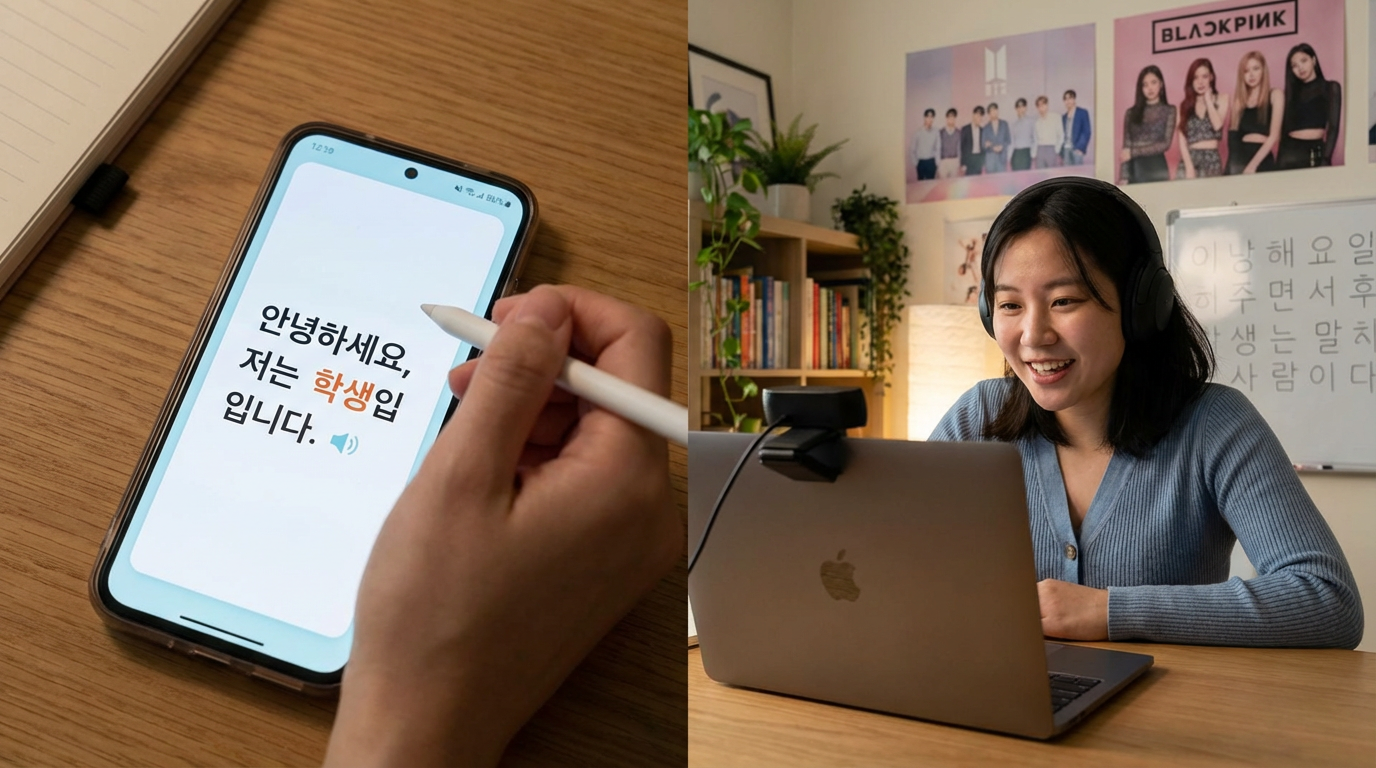
1. Watch with subtitles first. Start with Korean subtitles (한글 자막) rather than English. Seeing the Hangul while hearing the pronunciation creates a stronger neural connection.
2. Shadow the idols. When you watch a variety show or vlog, pause and repeat what the idols say exactly as they say it — this is the shadowing technique, and it's one of the fastest ways to improve pronunciation.
3. Use TalkMe for real practice. Reading phrases is one thing; using them in conversation is another. TalkMe (talkme.ai) provides AI-powered conversation practice where you can roleplay fan interactions, ask for pronunciation feedback, and practice natural responses.
4. Join Korean K-pop fan spaces. Follow Korean fan accounts on Twitter, join Discord servers with Korean-speaking fans, and try leaving comments in Korean on idol posts. Real-world usage is the best reinforcement.
5. Learn the Romanization first, then Hangul. For absolute beginners, romanization (romanization) is helpful for initial pronunciation, but transition to Hangul (한글) as quickly as possible — Korean script is phonetic and surprisingly easy to learn.
The 4-Week K-pop Korean Challenge
Here's a structured plan to master these phrases over one month:
Frequently Asked Questions
Q: Do K-pop fans actually use these phrases in real Korean conversations?
A: Absolutely. Many K-pop expressions have crossed over into everyday Korean youth language. "대박," "귀여워," and "화이팅" are used constantly in daily life in Korea, not just in fan contexts. Knowing K-pop Korean gives you genuinely useful everyday vocabulary.
Q: Should I learn Hangul (한글) first or just use romanization?
A: Learn Hangul. It's one of the world's easiest writing systems — it takes most learners just 1-2 weeks to master. Romanization is useful for pronunciation guidance, but Hangul will let you read Korean text messages, song lyrics, and fan posts.
Q: What's the difference between 최애 and 바이어스?
A: They overlap significantly, but 최애 (from Japanese fan culture) carries more intensity — it means "my absolute, number-one favorite." 바이어스 is directly borrowed from English "bias" and is more commonly used in international fan communities. Both are used in Korean fan spaces.
Q: Can these phrases help me in a K-pop concert in Korea?
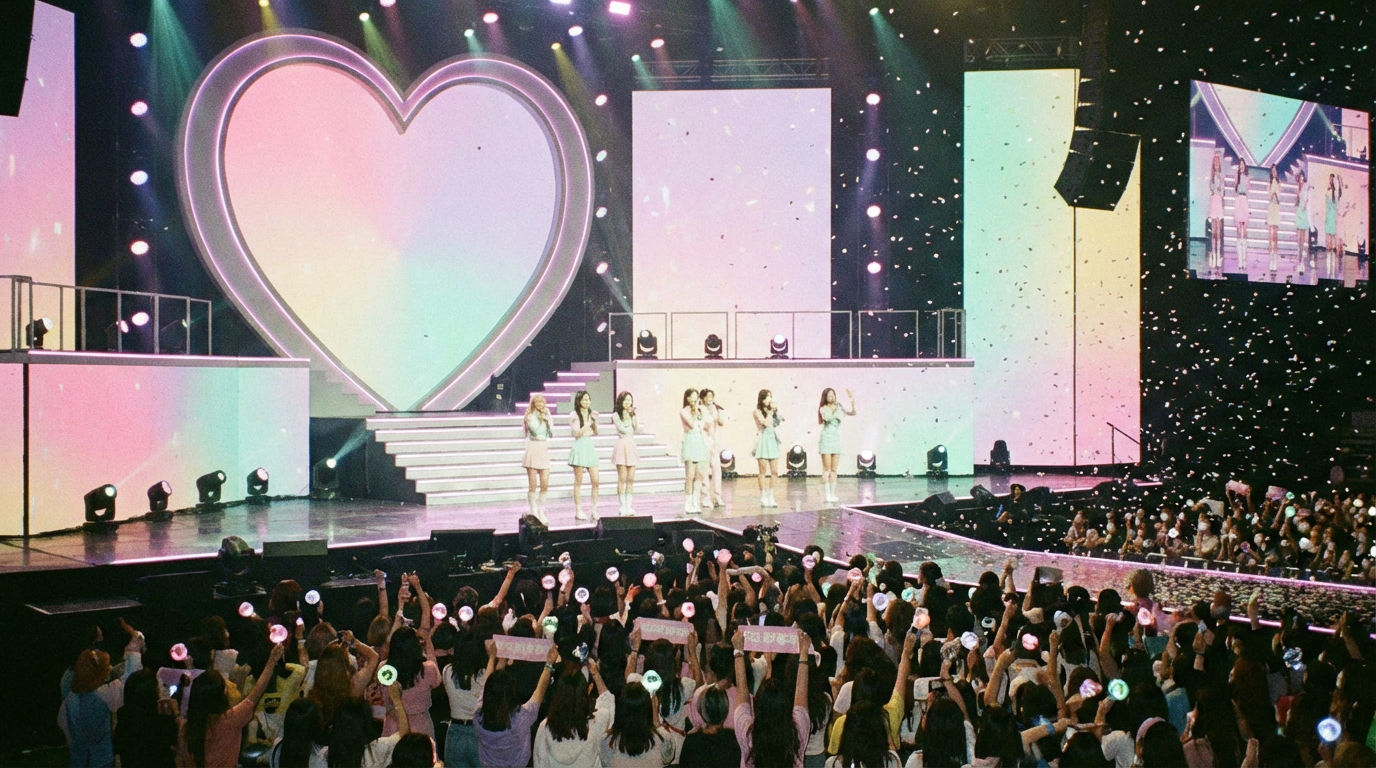
A: Yes! At Korean concerts, fans chant in Korean, not English. Knowing these phrases — especially 화이팅 and 대박 — will let you participate fully in fan chants and create an authentic concert experience.
Q: Is K-pop Korean different from formal Korean?
A: Yes, K-pop Korean is more casual, uses more slang, and incorporates internet speak. But the grammar foundations are the same, and the expressions are authentic contemporary Korean — just in a specific register. It's a great starting point, not a dead end.
Q: How can I practice these phrases with native speakers?
A: TalkMe (talkme.ai) is designed exactly for this — practice Korean conversation with AI in context-rich scenarios. You can even practice ordering at a Korean café, chatting with a K-pop fan at a concert, or discussing your favorite group with a native speaker.
Conclusion: Your K-pop Korean Journey Starts Now
You already know more Korean than you realize. Every time you watch a music video, hum along to a chorus, or feel something when your bias performs — that's language learning happening naturally.
These 10 phrases — 사랑해요, 화이팅, 귀여워, 아이돌, 바이어스, 최애, 고마워, 짱이야, 대박, and 화이팅 — are your foundation. They're the vocabulary that turns passive listening into active participation.
Start with one phrase today. Learn it in Hangul. Use it in a sentence. Share it with a fellow fan.
화이팅! You've got this!
Ready to take your K-pop Korean to the next level? Visit blog.talkme.ai for more Korean learning guides, or try TalkMe at talkme.ai for AI-powered conversation practice in Korean.

Comments
No comments yet.
Leave a Comment