
If you’ve ever said something like “I’m good in math” or “She arrived to the station,” you’re not alone. Prepositions are one of the most stubborn parts of English because they don’t always follow logical rules. They’re small words, but they carry a lot of meaning, and using the wrong one can make a sentence sound unnatural or confusing.
Many learners reach an intermediate or advanced level and still struggle with prepositions in everyday speech. That’s because memorizing vocabulary and grammar rules is not enough. Prepositions are tied to context, habits, and real-life usage.
What “wrong prepositions in speech” actually means
Using the wrong preposition usually happens when a speaker translates directly from their native language or guesses the word that sounds closest.
For example:
“Depend of” instead of “depend on”
“Married with” instead of “married to”
“Interested on” instead of “interested in”
These mistakes don’t usually stop communication, but they immediately signal that someone is not a native speaker. In professional or academic settings, this can affect confidence and clarity.
Where these mistakes usually come from
Most preposition errors come from three common sources:
Direct translation from your first language
Many languages use different prepositions or none at all.Learning words without their natural partners
For example, memorizing “afraid” without learning “afraid of.”Lack of real speaking practice
Prepositions are best learned through conversation, not just textbooks.
How to stop using the wrong prepositions: a step-by-step guide
Step 1: Learn prepositions with phrases, not alone
Instead of memorizing single words, learn them as chunks.
Not just: “interested”
Learn: “interested in”
Not just: “good”
Learn: “good at”
This builds natural habits.
Step 2: Notice prepositions when you read or listen
When watching shows, reading articles, or listening to podcasts:
Pay attention to how prepositions are used
Write down useful phrases
Repeat them out loud
Step 3: Practice with real conversation
You need to use prepositions in actual speech. That’s how your brain forms automatic patterns.
Apps like TalkMe AI let you simulate real conversations with an AI tutor. You can:
Practice role-play scenarios
Speak freely without pressure
Get instant feedback on unnatural phrasing
Step 4: Focus on common preposition pairs
Start with the most frequent combinations:
Step 5: Repeat until it feels automatic
Repetition is key. Short, daily speaking sessions work better than long, irregular study periods.
Practical tips and common mistakes
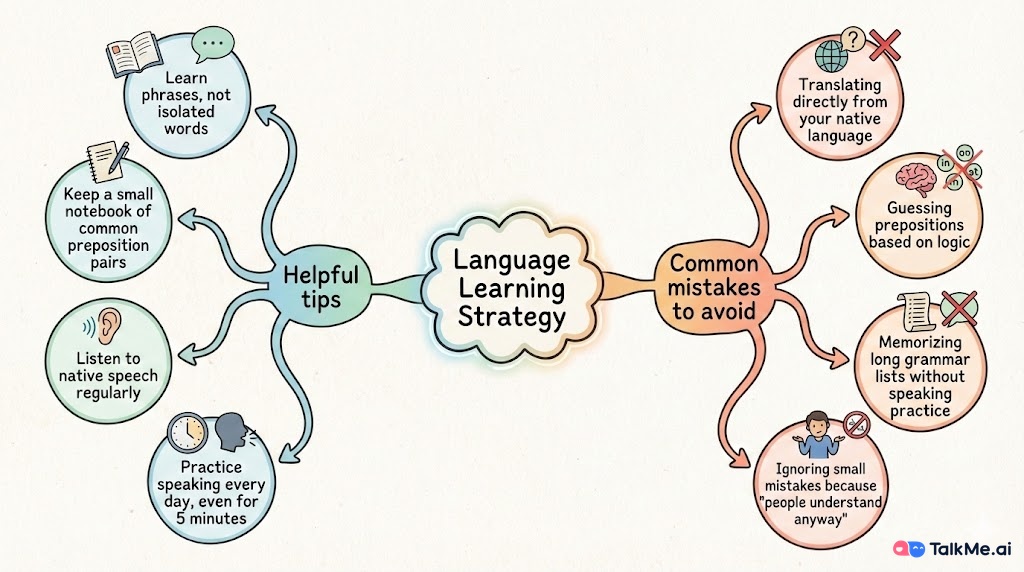
Helpful tips
Learn phrases, not isolated words
Keep a small notebook of common preposition pairs
Listen to native speech regularly
Practice speaking every day, even for 5 minutes
Using a conversation-focused app like TalkMe can help because it places prepositions in real-life contexts, such as ordering food, job interviews, or travel situations.
Common mistakes to avoid
Translating directly from your native language
Guessing prepositions based on logic
Memorizing long grammar lists without speaking practice
Ignoring small mistakes because “people understand anyway”
Quick reference chart
This type of chart is useful to review before speaking practice or conversations.
FAQ
Why are prepositions so hard to learn?
Because they rarely follow strict logic. Many are fixed combinations that must be learned through exposure and practice.
Is it okay if people still understand me?
Yes, but frequent mistakes can make your speech sound unnatural or less professional.
How long does it take to improve?
With daily speaking practice, most learners notice improvement in a few weeks.
What’s the fastest way to fix preposition mistakes?
Regular conversation practice with feedback. Tools like TalkMe AI help because you can practice real scenarios and correct mistakes immediately.
Key takeaways
Prepositions are small but crucial for natural-sounding English.
Most mistakes come from translation and lack of speaking practice.
Learn prepositions as part of phrases, not as single words.
Daily conversation practice builds automatic, correct usage.
If you want faster progress, start practicing real conversations instead of only reading grammar rules. Download TalkMe AI from the App Store or Google Play, try a few role-play scenarios, and notice how quickly your speech becomes more natural.




Comments
No comments yet.
Leave a Comment