

When you first start learning a new language, it feels safer to pronounce every word slowly and clearly. Many learners think this is the “correct” way to speak. But in real conversations, native speakers don’t talk like that. They connect sounds, reduce syllables, and let the rhythm carry the sentence forward.
If you sound stiff or overly careful when speaking, you’re not alone. The good news is that natural pronunciation is a skill you can train—once you understand what to change.
What It Means to Avoid Overpronouncing
Overpronouncing happens when you treat every word as a separate, fully stressed unit. This often sounds robotic or unnatural because real speech is more fluid.
For example:
Overpronounced: I / want / to / go / to / the / store
Natural speech: I wanna go to the store
Native speakers:
Link words together
Reduce unstressed syllables
Focus on rhythm instead of perfect individual words
Speaking naturally isn’t about being sloppy. It’s about following the real patterns of the language.
Where the Problem Usually Starts
Many learners overpronounce because of how they were taught.
Common causes include:
This is why someone can know a lot of vocabulary but still sound unnatural when speaking.
How to Stop Overpronouncing: A Step-by-Step Guide
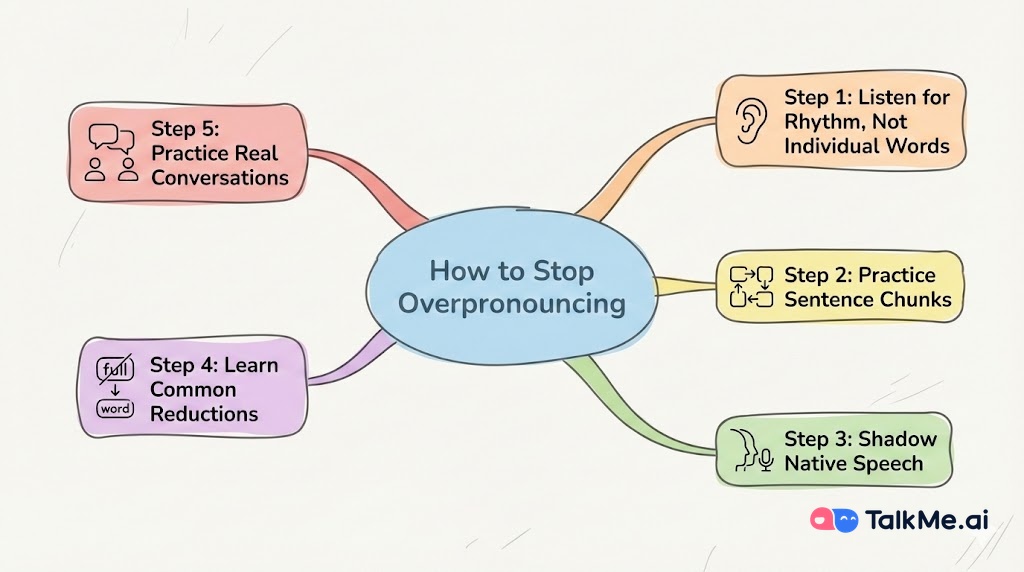
Step 1: Listen for Rhythm, Not Individual Words 🎧
Focus on how sentences flow instead of how each word sounds alone.
Listen to short clips from movies, podcasts, or interviews
Notice which words are stressed
Pay attention to how sounds connect
Step 2: Practice Sentence Chunks 🧩
Instead of practicing single words, repeat full phrases.
Examples:
“What are you doing?” → “Whatcha doing?”
“Did you eat yet?” → “Jeet yet?”
This helps your mouth learn natural rhythm.
Step 3: Shadow Native Speech 🗣️
Shadowing means listening and repeating at the same time.
How to do it:
Play a short sentence.
Repeat immediately after the speaker.
Try to match the speed and rhythm.
Even five minutes a day can make a difference.
Step 4: Learn Common Reductions ✂️
Native speech includes many reductions:
You don’t need to memorize everything. Start with the most common ones.
Step 5: Practice Real Conversations 🤝
Natural pronunciation improves fastest when you speak in context.
Using an AI conversation app like TalkMe can help because:
You can practice everyday scenarios
The AI responds naturally
It adapts to your level
You get speaking practice anytime
This kind of interactive practice helps your speech sound more natural without overthinking each word.
Tips, Advice, and Common Mistakes
What Helps
Speak in phrases, not isolated words
Focus on sentence stress
Listen more than you read
Practice short, realistic dialogues
Common Mistakes
Speaking too slowly to be “perfect”
Stressing every word equally
Ignoring listening practice
Only reading textbooks aloud
If you want structured speaking practice, tools like TalkMe let you rehearse natural conversations instead of memorizing isolated words.
FAQ
Is overpronouncing always bad?
No. Clear pronunciation is important in formal speeches or presentations. But in everyday conversation, overly careful speech can sound unnatural.
Will reducing words make me harder to understand?
Not if you follow natural patterns. Native speakers expect these reductions.
How long does it take to sound more natural?
Many learners notice improvement in a few weeks with daily listening and speaking practice.
Can an app really help with natural pronunciation?
Yes—especially apps that simulate real conversations. TalkMe, for example, lets you practice speaking in realistic situations, which trains natural rhythm and flow.
Quick Visual Summary
Key Takeaways
Natural speech is about rhythm, not perfect individual words.
Overpronouncing makes you sound robotic.
Practice chunks, reductions, and shadowing.
Real conversation practice speeds up progress.
If you want a simple way to practice natural, everyday conversations, try TalkMe. Search for it on the App Store or Google Play, download it, and start speaking with an AI tutor anytime.




Comments
No comments yet.
Leave a Comment