

When you’re learning a new language, numbers and time expressions often seem simple at first. But in real conversations, they quickly become confusing. You might know how to count to one hundred, yet still freeze when someone asks about a meeting time, a price, or a date.
Small mistakes with numbers or time can cause big misunderstandings. A missed appointment, the wrong bus, or an incorrect payment can all happen because of a single misunderstood number.
Why Numbers and Time Expressions Cause Problems
Numbers, dates, and time expressions are everywhere in daily communication. They appear in schedules, prices, phone numbers, addresses, and even casual conversations.
Here’s why they’re tricky:
Fast pronunciation: Native speakers often say numbers very quickly.
Different formats: Dates and time formats vary by country.
Similar sounds: Words like “thirteen” and “thirty” can sound almost identical.
Context changes meaning: “Half five” can mean 5:30 in some places, but something else in others.
If you hesitate or mishear a number, the entire sentence can become confusing.
Where These Problems Usually Appear
Most learners notice difficulties in these common situations:
Booking flights or hotels
Talking about schedules or appointments
Understanding prices in shops
Giving phone numbers or addresses
Following instructions with times or quantities
In these moments, the conversation moves quickly, and there’s little time to stop and ask for repetition.
How to Handle Numbers, Dates, and Time: A Step-by-Step Guide
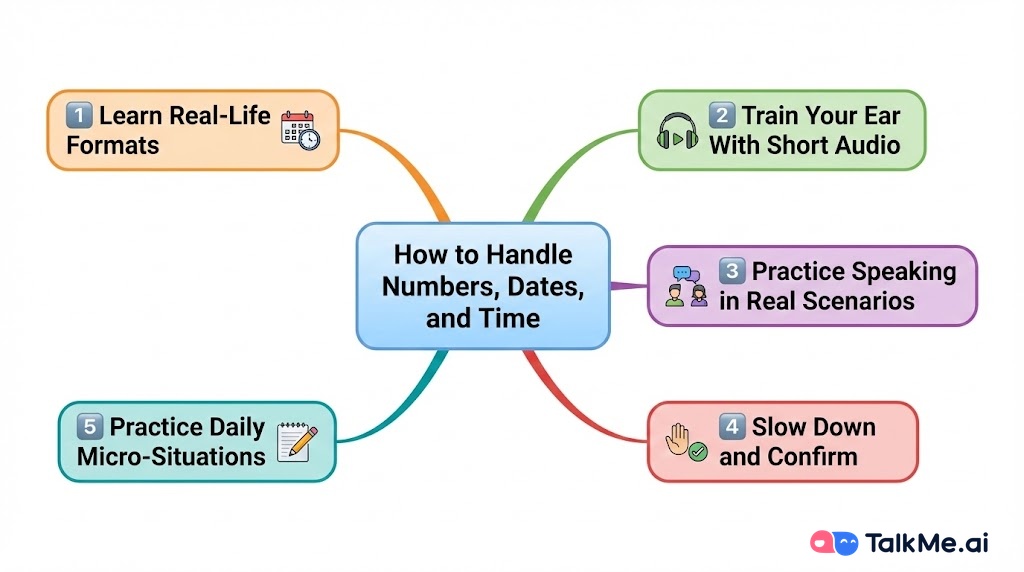
1️⃣ Learn Real-Life Formats
Focus on how numbers and time are actually used in daily situations. For example:
Prices: $12.50 → “twelve fifty”
Time: 7:45 → “seven forty-five”
Dates: 04/05 → could be April 5 or May 4 depending on the country
2️⃣ Train Your Ear With Short Audio
Listen to short clips of numbers and times instead of long dialogues. This helps your brain recognize patterns faster.
Try exercises like:
Hearing a number and writing it down
Matching spoken times to clocks
Repeating phone numbers out loud
3️⃣ Practice Speaking in Real Scenarios
Use role-play to simulate real conversations:
Ordering food and paying
Scheduling a meeting
Asking about store hours
Apps like TalkMe AI provide realistic role-play conversations with an AI tutor that adapts to your level, so you can practice numbers and time expressions in natural contexts instead of isolated drills.
4️⃣ Slow Down and Confirm
In real conversations:
Repeat numbers back:
“So, that’s fifteen dollars, right?”Ask for confirmation:
“Did you say 3:30 or 3:13?”
Native speakers do this too, especially over the phone.
5️⃣ Practice Daily Micro-Situations
Spend just a few minutes each day on practical tasks:
Say the time whenever you check your phone
Read prices aloud while shopping
Dictate your own phone number and record it
These small habits build automatic responses.
Quick Reference Chart
Useful Tips, Advice, and Common Mistakes
Tips
Listen for stress patterns: “thirTEEN” vs. “THIRty.”
Write numbers down immediately during conversations.
Use short daily speaking drills to build speed.
Common Mistakes
Mixing up teen numbers and tens.
Assuming date formats are the same everywhere.
Trying to translate numbers in your head instead of recognizing them instantly.
Helpful Tool
If you struggle to react quickly in real conversations, practicing with an AI tutor like TalkMe can help. It simulates everyday situations—like booking tickets or setting meeting times—so you can build confidence before facing real speakers.
FAQ
Why do I understand numbers in class but not in real life?
In classrooms, numbers are spoken slowly and clearly. Real conversations are faster and less predictable.
What’s the best way to practice time expressions?
Daily repetition in real contexts works best. For example, say the time aloud whenever you check it.
How can I stop confusing numbers like 14 and 40?
Focus on stress and rhythm. Listen and repeat pairs like “fourteen” and “forty” until the difference feels natural.
Can AI tools really help with this?
Yes. Tools like TalkMe create realistic conversations where you must react to times, prices, and numbers naturally, which improves both listening and speaking skills.
Key Takeaways
Numbers and time expressions cause problems because of speed, pronunciation, and format differences.
Most mistakes happen in real-life situations like travel, shopping, and scheduling.
Short, daily practice in realistic scenarios is the fastest way to improve.
Confirmation and repetition are normal and helpful strategies.
If you want structured, real-life speaking practice, try using TalkMe. Search for TalkMe on the App Store or Google Play, download the app, and start practicing everyday conversations with a lifelike AI tutor.




Comments
No comments yet.
Leave a Comment