

Everyone has an accent. It’s a natural result of where you grew up, what languages you speak, and how you learned to pronounce sounds. But when an accent becomes strong enough to interfere with clarity, it can lead to repeated misunderstandings at work, in class, or in everyday conversations.
You might notice people asking you to repeat yourself often. Maybe they misunderstand important details, or conversations feel more tiring than they should. This isn’t about sounding “native.” It’s about being clearly understood.
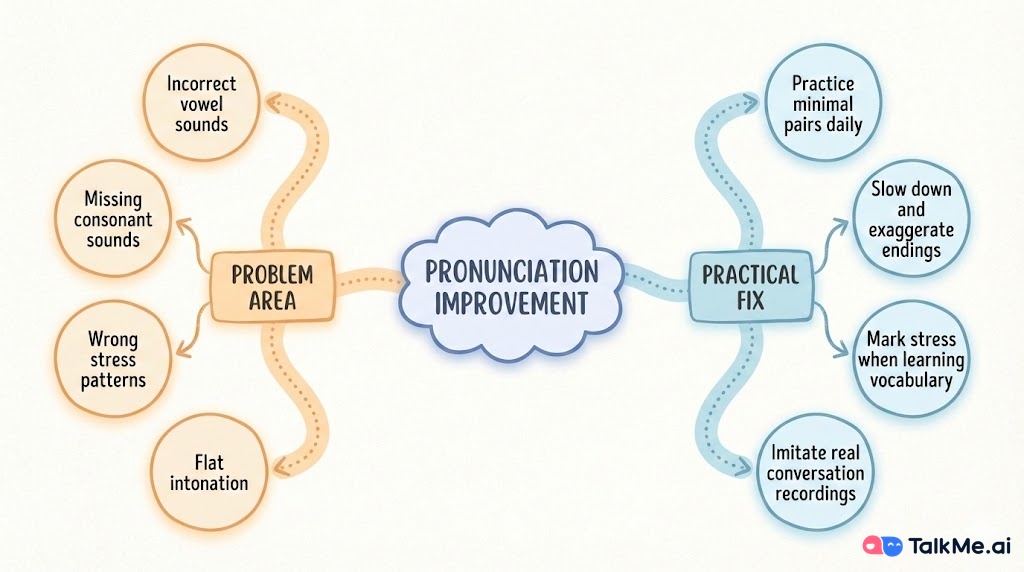
What people really mean when they talk about accent misunderstandings
When someone says a strong accent is causing confusion, they’re usually not talking about the accent itself. The real issue is pronunciation patterns that make certain sounds or stress patterns hard to recognize.
Common causes include:
Replacing unfamiliar sounds with ones from your native language
Stressing the wrong syllable in words
Speaking too fast without clear pauses
Using intonation patterns that confuse listeners
For example, a small change in vowel sound can turn “ship” into “sheep,” or “beach” into something very different. These tiny differences can lead to awkward or even embarrassing situations.
Where these problems usually show up
Accent-related misunderstandings tend to appear in situations where clarity matters most:
Job interviews or client calls
Team meetings
Customer service roles
Presentations or public speaking
Daily life in an English-speaking environment
In professional settings, communication errors can affect confidence, reputation, and even career opportunities.
How to reduce accent misunderstandings: a step-by-step guide
1️⃣ Identify your most confusing sounds
Instead of trying to “fix” your entire accent, focus on the specific sounds that cause confusion.
How to do this:
Ask native speakers which words they struggle to understand
Record yourself speaking
Compare your pronunciation with a standard model
2️⃣ Learn the correct mouth and tongue positions
Many pronunciation problems come from physical habits. The way your tongue and lips move matters.
For example:
The “th” sound requires the tongue between the teeth
The “r” sound in English is different from many other languages
Long and short vowels must be clearly distinguished
Watching demonstrations or practicing with guided tools helps build the right muscle memory.
3️⃣ Practice stress and rhythm
English is a stress-timed language, meaning some syllables are stronger than others.
If you stress the wrong syllable, listeners may not recognize the word at all.
Example:
PREsent (noun)
preSENT (verb)
Practice:
Listening to natural conversations
Repeating sentences with the same rhythm
Marking stressed syllables in new words
4️⃣ Use guided conversation practice
Real improvement happens when you speak regularly in realistic situations.
This is where tools like TalkMe AI can help. The app simulates everyday conversations, lets you practice role-plays, and adapts to your level. Instead of memorizing isolated sounds, you learn to speak clearly in real contexts.
5️⃣ Record, review, and adjust
Consistent feedback is essential.
Build a simple habit:
Record short daily speaking exercises
Listen for unclear words
Repeat until the pronunciation becomes natural
Quick comparison: common causes vs. solutions
Practical tips to sound clearer, not “native”
Focus on clarity, not accent removal
Slow down slightly when speaking
Pause between important ideas
Learn common phrases as whole units
Practice out loud, not silently
If you use an app like TalkMe, choose role-plays that match your real-life situations—meetings, travel, or interviews—so your practice feels relevant.
Common mistakes to avoid
Trying to copy a native accent perfectly
Practicing only grammar and vocabulary
Ignoring stress and rhythm
Speaking too fast to sound fluent
FAQ
Is having an accent a bad thing?
Not at all. Everyone has an accent. The goal is simply to be understood easily.
How long does it take to improve pronunciation?
With daily practice, most learners notice clearer speech within a few weeks. Major improvements usually take a few months.
Do I need a human tutor?
A tutor can help, but many learners improve using AI conversation tools. Apps like TalkMe provide instant feedback and unlimited speaking practice.
Should I focus on grammar or pronunciation first?
Both matter, but if people can’t understand your speech, pronunciation should be a top priority.
Key takeaways
Accent misunderstandings usually come from specific sound and stress issues
You don’t need to lose your accent—just improve clarity
Focus on problem sounds, rhythm, and real conversation practice
Daily speaking and feedback make the biggest difference
If you want structured speaking practice without pressure, try an AI tutor. Search TalkMe on the App Store or Google Play, download the app, and start practicing real conversations today.




Comments
No comments yet.
Leave a Comment