

Many language learners reach a stage where their grammar is correct and their vocabulary is decent—yet something still feels off. Conversations sound stiff. Sentences feel memorized. Native speakers may understand you, but they can also sense that your speech doesn’t flow naturally.
This is what people mean when they describe speech as “unnatural” or “robotic.” It’s not about intelligence or effort. It’s usually about how the language is practiced.
What “unnatural” speech actually means
When speech sounds robotic, it usually has one or more of these traits:
Sentences are grammatically correct but overly formal
Intonation stays flat or mechanical
Responses sound memorized instead of spontaneous
Word choices don’t match real-life conversations
For example:
Natural speech tends to be shorter, more relaxed, and shaped by context.
Where the problem usually comes from
Most robotic speech isn’t caused by lack of knowledge. It usually comes from the way people learn.
Common causes include:
Over-reliance on textbooks
Many learning materials teach formal or outdated expressions.Memorizing full sentences
Learners repeat scripts instead of building flexible speaking skills.Lack of real conversation practice
Reading and writing improve accuracy, but speaking improves natural flow.Fear of making mistakes
When learners try to be “perfect,” their speech becomes stiff.
How to Sound More Natural: A Step-by-Step Guide
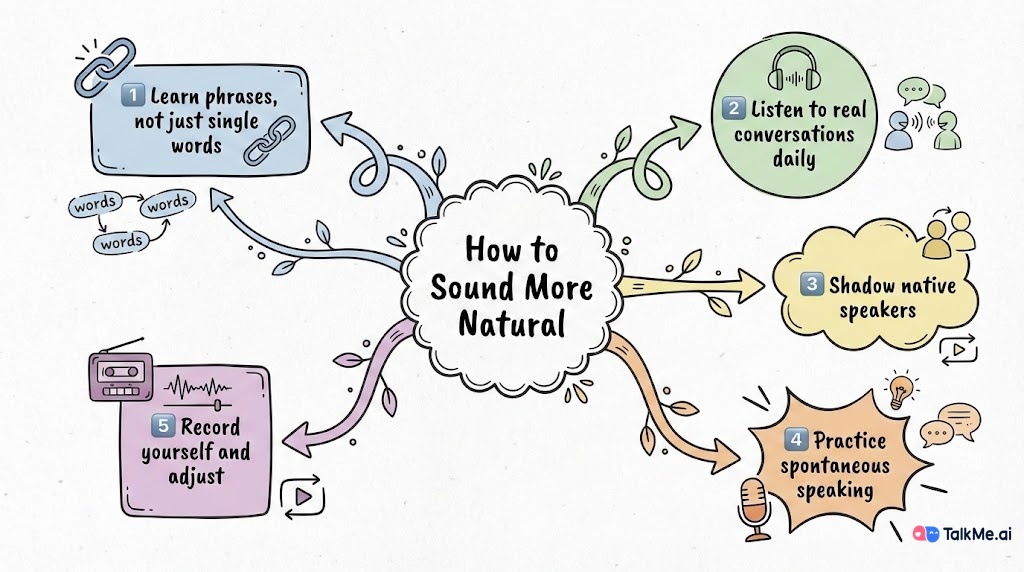
1️⃣ Learn phrases, not just single words
Native speakers think in chunks, not isolated vocabulary.
Instead of learning:
“make” + “a” + “decision”
Learn:
“make a decision” as one unit
This helps speech flow more naturally.
2️⃣ Listen to real conversations daily
Focus on:
Podcasts
Casual interviews
Street interviews
TV dialogue
Pay attention to:
Fillers (“well,” “you know,” “kind of”)
Short responses
Natural pauses
3️⃣ Shadow native speakers
Shadowing means:
Listen to a short sentence
Repeat it immediately
Copy the rhythm and tone
Do this for 5–10 minutes daily. It improves:
Intonation
Speed
Natural phrasing
4️⃣ Practice spontaneous speaking
Instead of memorizing scripts, try:
Describing your day
Explaining what you see around you
Reacting to simple questions
Apps like TalkMe simulate real-life conversations with an AI tutor, so you can practice spontaneous responses instead of rehearsed lines.
5️⃣ Record yourself and adjust
Once or twice
Answer to a question
Listen to it
Compare with native speech
Ask yourself:
Does it sound too formal?
Are sentences too long?
Is the tone flat?
Small adjustments make a big difference.
Quick comparison: robotic vs natural habits
Practical tips, advice, and common mistakes
What helps most:
Speak every day, even for 5 minutes
Use shorter sentences
Learn everyday phrases
Listen more than you read
Common mistakes to avoid:
Trying to sound “perfect” instead of natural
Using formal phrases in casual situations
Translating word-for-word from your native language
Memorizing dialogues without understanding them
If you don’t have regular speaking partners, tools like TalkMe can provide consistent conversation practice with realistic scenarios and adaptive responses.
FAQ
Why do I sound robotic even if my grammar is correct?
Because natural speech depends on rhythm, intonation, and context—not just grammar rules.
How long does it take to sound more natural?
With daily speaking practice, many learners notice improvement within a few weeks.
Is memorization always bad?
No. Memorizing useful phrases is good. Memorizing long scripts is what causes robotic speech.
Can AI help me sound more natural?
Yes—if it focuses on conversation rather than drills. Tools like TalkMe simulate real-life situations and respond dynamically, which encourages more natural speaking patterns.
Key takeaways
Robotic speech usually comes from memorization and lack of real conversation.
Natural speaking relies on phrases, rhythm, and context.
Daily listening and spontaneous speaking practice are essential.
Short, flexible responses sound more natural than perfect long sentences.
If you want a simple way to practice real conversations every day, download TalkMe and start speaking with a lifelike AI tutor.
Search “TalkMe” on the App Store or Google Play to get started.




Comments
No comments yet.
Leave a Comment