

We’ve all had that moment: you open your mouth to say something in English, and suddenly you’re stuck. Should it be went or have gone? Was doing or did? If you often get confused about tenses, you’re not alone. Even advanced learners hesitate when time, context, and grammar collide.
English tenses are less about memorizing charts and more about understanding how time works in real communication. Once you see the logic behind them, things start to feel much more natural.
Why Tenses Cause So Much Confusion
Many learners study long lists of tense rules but still hesitate in conversations. That’s because tenses are not just grammar forms—they’re ways of expressing time, intention, and perspective.
For example:
I ate dinner. → A finished action in the past.
I was eating dinner. → An action in progress in the past.
I have eaten dinner. → The result matters now.
These differences are subtle, and textbooks often present them in isolation instead of real-life situations.
Where the Problems Usually Start
Most tense confusion comes from three common sources:
Translating directly from your native language
Memorizing rules without context
Lack of real speaking practice
Many languages use fewer tense forms than English, so learners try to apply familiar patterns. This leads to mistakes like:
Yesterday I go to the store.
I am knowing the answer.
I have seen him last week.
These errors are normal—but they become habits without proper practice.
How to Stop Getting Confused About Tenses: A Step-by-Step Guide
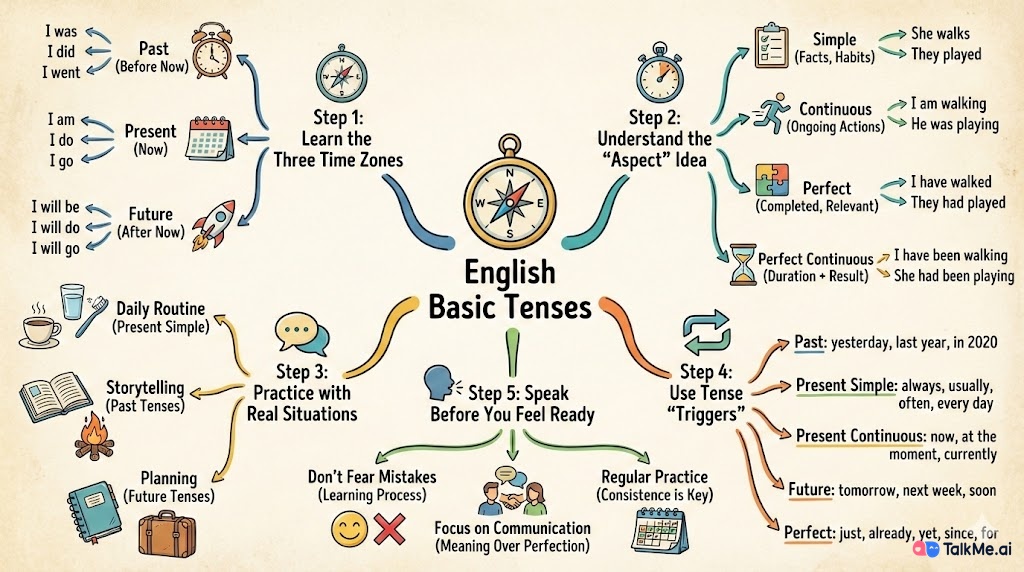
🧭 Step 1: Learn the Three Time Zones
Instead of starting with 12 tenses, think of English in three simple categories:
Once this feels clear, you can add more detail.
⏱️ Step 2: Understand the “Aspect” Idea
Each time zone has different aspects:
Think of aspect as the camera angle on an action.
💬 Step 3: Practice with Real Situations
Instead of grammar drills, connect tenses to real-life contexts:
Talking about yesterday → Past simple
Describing what’s happening now → Present continuous
Sharing life experiences → Present perfect
Apps like TalkMe AI are useful here because they simulate everyday conversations with an AI tutor. You practice tenses while ordering food, chatting with friends, or describing your day—just like real life.
🔁 Step 4: Use Tense “Triggers”
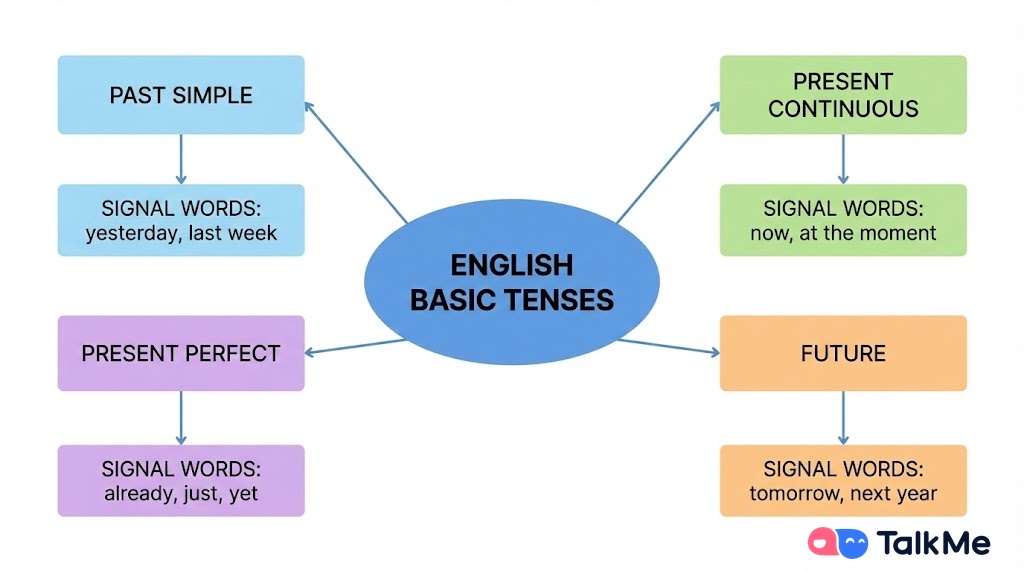
Certain words naturally point to certain tenses:
Recognizing these patterns helps you choose the correct form quickly.
🗣️ Step 5: Speak Before You Feel Ready
Fluency comes from use, not perfection. Try this daily routine:
Talk about your day in the past tense.
Describe what you’re doing now.
Say one plan for tomorrow.
If you use a conversation app like TalkMe, you can practice this routine with instant feedback and customized role-play.
Quick Tense Comparison Chart
This kind of summary chart is useful to keep on your phone or notebook for quick reference.
Practical Tips and Common Mistakes
1. Don’t memorize all 12 tenses at once.
Focus on the most common ones: present simple, past simple, and present perfect.
2. Avoid translating directly.
Think in English time concepts instead.
3. Notice patterns in conversations.
Pay attention to how native speakers talk about time.
4. Practice speaking, not just writing.
Interactive tools like TalkMe help you use the right tense naturally in conversation.
FAQ
Why do I keep mixing up past simple and present perfect?
Because many languages use only one tense for both. In English, the present perfect connects the past to the present, while the past simple is completely finished.
How long does it take to master English tenses?
With daily speaking practice, most learners become comfortable with the main tenses in a few months.
Is it okay to make tense mistakes when speaking?
Yes. Communication matters more than perfection. Regular conversation practice helps you improve faster.
What’s the best way to practice tenses every day?
Short, daily speaking sessions work best. Using an AI conversation partner like TalkMe makes this easy, because you can practice anytime without pressure.
Key Takeaways
Tenses are about time and perspective, not just rules.
Focus on three time zones first: past, present, and future.
Practice with real-life conversations instead of isolated exercises.
Daily speaking practice builds natural tense usage.
If you want to stop second-guessing your verb forms, the next step is simple: start using English every day. Download TalkMe AI from the App Store or Google Play, and practice real conversations with a smart AI tutor that adapts to your level.




Comments
No comments yet.
Leave a Comment