

Speaking English in real life can feel very different from studying it in a classroom. You might know the grammar, remember the vocabulary, and still feel like your sentences come out awkward, flat, or overly formal. Many learners describe this feeling as sounding “unnatural” or “stiff,” even when they’re technically correct.
The good news: this problem is extremely common, and it’s fixable with the right approach.
What it really means to sound unnatural in English
When someone sounds stiff in English, it usually doesn’t mean their grammar is wrong. Instead, it means their speech doesn’t match how native speakers actually talk in daily situations.
This often shows up as:
Sentences that are too formal for casual conversations
Perfect grammar but unusual phrasing
Slow, hesitant speech with long pauses
Overuse of textbook expressions
For example:
“I would like to consume food now.”
vs.
“I’m kind of hungry. Want to grab something to eat?”
Both are correct, but only one sounds natural in everyday speech.
Where the problem usually comes from
Most learners who sound stiff share a few common habits:
1. Overreliance on textbooks
Many textbooks teach safe, formal English. That’s useful for exams, but not always for real conversations.
2. Translating from your native language
If you build sentences word-for-word in your head, they often come out sounding unnatural.
3. Not enough speaking practice
Reading and listening alone won’t train your mouth to produce natural rhythm and tone.
4. Fear of making mistakes
Trying to be “perfect” often leads to slow, rigid speech.
How to stop sounding stiff: a step-by-step approach
1. Listen for patterns, not just words
Instead of memorizing single vocabulary items, pay attention to how phrases are used in real conversations.
For example:
“Sounds good.”
“I’m not sure about that.”
“Give me a second.”
These chunks make your speech smoother and more natural.
2. Copy real conversations out loud
Choose short clips from podcasts, shows, or interviews.
Listen to one sentence and repeat it exactly—same speed, same tone, same rhythm.
This is called shadowing, and it helps your speech flow more naturally.
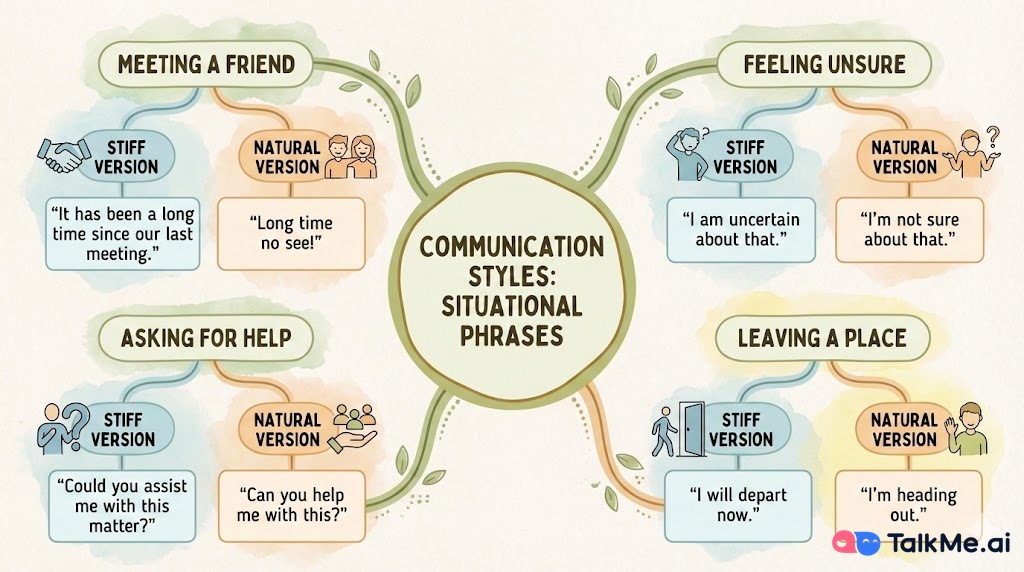
3. Replace formal phrases with everyday ones
Create a small list of common replacements:
Practice these in short dialogues.
4. Practice role-play conversations
Real progress comes from speaking in situations that feel real:
Ordering coffee
Small talk with coworkers
Asking for directions
Casual phone calls
Apps like TalkMe simulate everyday conversations with an AI tutor, so you can practice natural dialogue without the pressure of a real person. This kind of role-play helps you move from “textbook English” to real-world English.
5. Focus on rhythm, not perfection
Natural speech is about flow, not flawless grammar.
Try this rule:
If people understand you, keep going.
Fix mistakes later, not in the middle of the sentence
This kind of side-by-side comparison makes it easier to spot what sounds natural.
Practical tips and common mistakes
Tips
Speak every day, even for five minutes.
Record yourself and listen back.
Learn phrases, not just single words.
Practice real-life scenarios, not just exam topics.
Common mistakes
Memorizing long, formal sentences.
Translating directly from your native language.
Speaking too slowly to avoid errors.
Only practicing reading and writing.
If you struggle to find speaking partners, structured conversation tools like TalkMe can give you daily, low-pressure practice with realistic scenarios.
FAQ
Why do I sound unnatural even though my grammar is correct?
Because natural speech depends on rhythm, tone, and common phrases—not just grammar rules.
How long does it take to sound more natural?
With daily speaking practice, many learners notice improvement in a few weeks.
Is it better to focus on vocabulary or conversation?
Conversation. Vocabulary becomes natural only when used in real situations.
What if I don’t have anyone to practice with?
You can use conversation-based apps like TalkMe, which simulate real-life dialogues and adapt to your level.
Key takeaways
Sounding stiff usually comes from formal phrasing and lack of speaking practice.
Natural English relies on common phrases and smooth rhythm.
Role-play and daily conversation practice make the biggest difference.
Focus on communication first, perfection later.
If you want a simple way to practice real conversations every day, download TalkMe and start speaking with its AI tutor.
Search “TalkMe” on the App Store or Google Play and try your first conversation today.




Comments
No comments yet.
Leave a Comment