

Long pauses while speaking can make even simple conversations feel stressful. You may know the right words, but they seem to arrive too slowly. The silence between sentences grows, and confidence starts to drop. This happens to many language learners, and the good news is that it’s a fixable habit.
Why Do People Pause So Much While Speaking?
Pauses usually don’t come from lack of knowledge alone. They often come from how the brain processes language in real time.
Common reasons include:
Translating from your native language before speaking
Fear of making mistakes
Limited speaking practice
Trying to sound “perfect” instead of natural
Lack of automatic vocabulary recall
When speaking doesn’t feel automatic, the brain needs extra time to build each sentence. That delay shows up as long pauses.
Where the Problem Usually Starts
Most learners spend far more time reading and listening than speaking. This creates a gap:
Without regular speaking practice, the brain doesn’t build the reflex to respond quickly. So even if you know the words, you still pause while trying to organize them.
How to Stop Pausing Too Much While Speaking: A Step-by-Step Guide
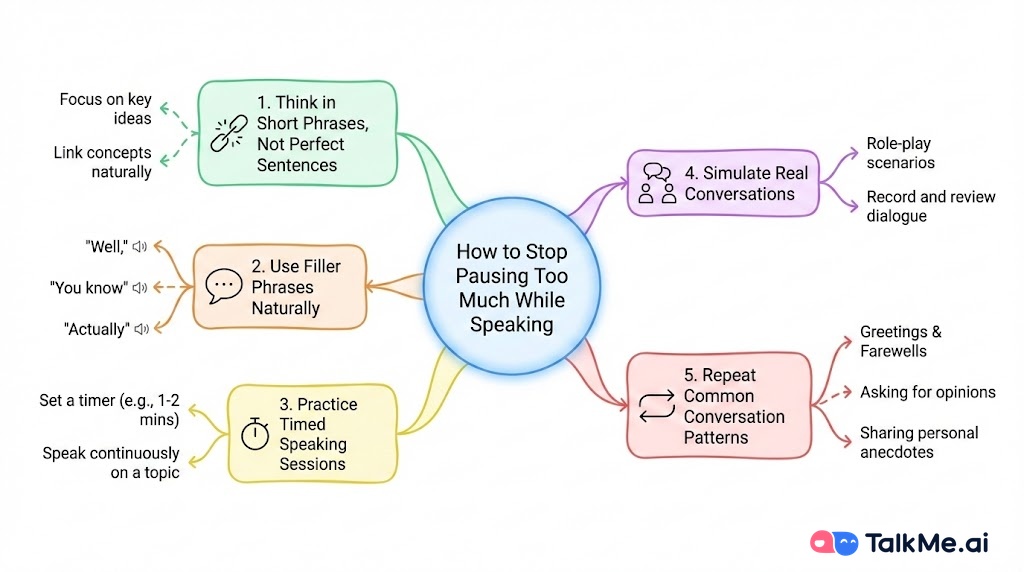
1. Think in Short Phrases, Not Perfect Sentences
Instead of building long, complex sentences, speak in small chunks.
Example:
Instead of: “Yesterday I went to a restaurant with my friend and we ordered seafood…”
Try: “Yesterday, I went out. With a friend. We ate seafood.”
Fluency grows from flow, not perfection.
2. Use Filler Phrases Naturally
Native speakers use small phrases to keep the conversation moving.
Examples:
“Let me think…”
“That’s a good question.”
“Well, I guess…”
These buy you time without creating awkward silence.
3. Practice Timed Speaking Sessions
Set a timer for 60 seconds and talk about one topic without stopping.
Topics can be simple:
What you did today
Your favorite food
Your last trip
The goal is continuous speech, not perfect grammar.
4. Simulate Real Conversations
Speaking improves faster when it feels like real interaction.
Apps like TalkMe let you:
Practice role-play situations
Talk with an AI tutor
Adjust difficulty to your level
This kind of environment helps your brain respond faster because it feels like a real conversation, not a classroom exercise.
5. Repeat Common Conversation Patterns
Fluency comes from repetition.
Practice structures like:
“I usually…”
“I think that…”
“In my opinion…”
The more you repeat them, the faster they come out.
Quick Comparison: Hesitant vs. Fluent Speaking Habits
This table works well as a quick visual summary for readers who want a fast comparison.
Practical Tips and Common Mistakes
Tips
Speak every day, even for five minutes
Record yourself and listen back
Focus on rhythm, not perfect grammar
Use conversation apps like TalkMe for daily speaking drills
Common mistakes
Waiting until the sentence is “perfect” before speaking
Translating every word mentally
Avoiding speaking practice because of fear
Memorizing long sentences instead of patterns
FAQ
Why do I pause even when I know the words?
Because your brain hasn’t automated the speaking process yet. You may understand the language, but speaking requires fast recall and structure building.
How long does it take to become more fluent?
With daily speaking practice, many learners notice smoother speech within a few weeks.
Is it okay to use filler words?
Yes. Natural filler phrases keep the conversation flowing and sound more human than long silence.
Can an app really help with speaking fluency?
Yes, especially if it focuses on conversation. Tools like TalkMe provide interactive speaking practice, which is the key to reducing hesitation.
Key Takeaways
Long pauses usually come from lack of speaking practice, not lack of knowledge.
Short phrases create smoother, more natural speech.
Daily timed speaking exercises build automatic responses.
Realistic conversation practice speeds up fluency.
If you want to speak more smoothly without awkward pauses, start practicing real conversations every day.
Search for TalkMe on the App Store or Google Play and try a few short speaking sessions. Even a few minutes a day can make your speech faster and more natural.




Comments
No comments yet.
Leave a Comment