

Verb tenses shape how we talk about time. Whether you’re describing yesterday’s meeting, today’s routine, or next year’s plans, choosing the right tense makes your meaning clear and natural. Many learners understand vocabulary but still feel uncertain when they have to switch between time frames. That’s because mastering verb tenses requires both understanding the rules and practicing them in real conversations.
Understanding how tenses express time
English mainly uses three core time frames:
Each of these categories includes several forms, such as simple, continuous, perfect, and perfect continuous. The good news is that most everyday conversations rely heavily on just a few common patterns.
Where learners usually struggle
Many learners face similar issues:
Mixing up past and present forms
Overusing “will” for every future situation
Forgetting verb endings like -ed or -s
Translating directly from their native language
Knowing grammar rules but freezing during conversation
These problems usually happen because learners practice grammar in isolation, not in real communication.
How to master past, present, and future tenses: a step-by-step guide
Step 1: Start with the simple forms
Focus first on the most common structures:
Simple past: I watched a movie.
Simple present: I watch movies on weekends.
Simple future: I will watch a movie tonight.
Don’t try to learn every tense at once. Master these three before moving on.
Step 2: Connect tenses to real situations
Think about your daily life:
What did you do yesterday?
What are you doing now?
What will you do tomorrow?
Practicing with personal examples makes the grammar easier to remember.
Step 3: Learn the most useful patterns
Instead of memorizing long grammar tables, focus on these practical structures:
Step 4: Practice speaking, not just writing
Grammar becomes natural only when you use it in conversation. Short, daily speaking sessions help you switch between tenses automatically.
Some learners use AI conversation tools like TalkMe, which simulate real-life scenarios and let you practice describing past experiences, current situations, and future plans in natural dialogue.
Step 5: Review through repetition
Try this daily routine:
Describe yesterday in three sentences
Talk about your current day in three sentences
Explain your plan for tomorrow in three sentences
This simple exercise reinforces all three time frames every day.
Practical tips and common mistakes
Tips
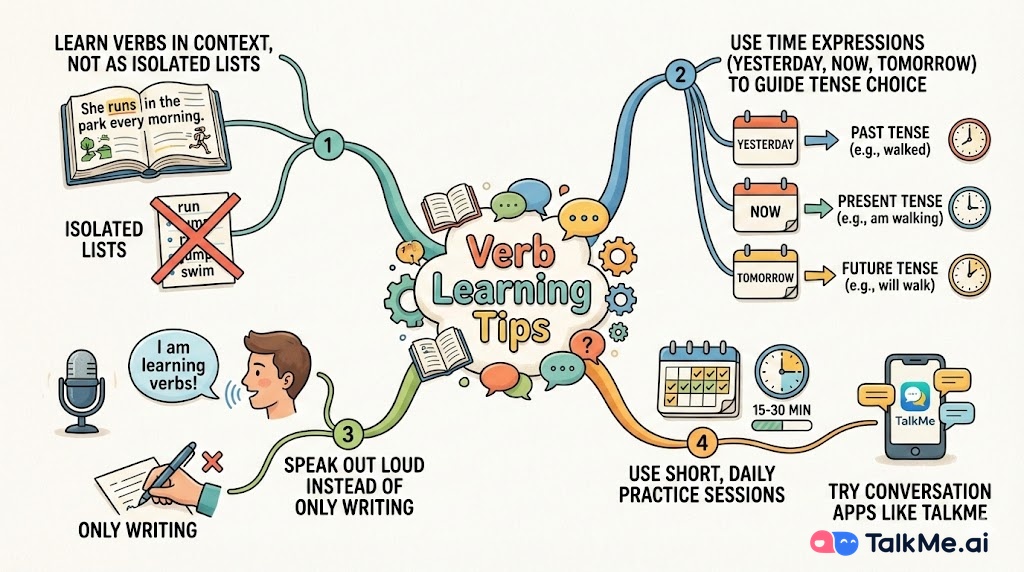
Learn verbs in context, not as isolated lists
Use time expressions (yesterday, now, tomorrow) to guide tense choice
Speak out loud instead of only writing
Use short, daily practice sessions instead of long weekly ones
Try conversation apps like TalkMe for realistic speaking practice
Common mistakes
Saying “Yesterday I go to work” instead of “Yesterday I went to work”
Using present tense for future plans without context
Memorizing rules without applying them in speech
Avoiding past tense because irregular verbs feel difficult
Quick reference chart
This is a visual-style summary that can be turned into a simple infographic or study card:
FAQ
Which tense should I learn first?
Start with the simple present, simple past, and simple future. These cover most everyday conversations.
Why do I understand grammar but still make mistakes?
Because grammar knowledge and speaking ability are different skills. You need repeated, real-time practice.
How long does it take to master verb tenses?
With daily speaking practice, most learners see noticeable improvement within a few weeks.
Can an AI app really help with tenses?
Yes. Apps like TalkMe create realistic conversations where you naturally switch between time frames, which is much more effective than memorizing rules alone.
Key takeaways
English tenses help you express time clearly.
Start with simple past, present, and future forms.
Practice with real-life examples every day.
Speaking practice is more important than memorizing rules.
Short, consistent sessions lead to faster progress.
If you want a practical way to practice real conversations using all three time frames, download TalkMe. Search for it on the App Store or Google Play, start a short speaking session, and put your tense skills into action today.




Comments
No comments yet.
Leave a Comment