

Many language learners share the same quiet worry: Am I saying this correctly?
You might read, listen, and memorize vocabulary, but when it’s time to speak, uncertainty about pronunciation can hold you back. That hesitation often becomes the biggest barrier to real conversation.
If you’ve ever paused mid-sentence because you weren’t sure how a word should sound, you’re not alone. The good news is that this problem is common—and very fixable with the right approach.
Why Pronunciation Uncertainty Happens
Pronunciation is different from grammar or vocabulary because you can’t always “see” mistakes. You might think a word sounds correct, but native speakers hear something slightly off.
Common reasons learners doubt their pronunciation:
Limited speaking practice
No real-time correction
Influence from your native language
Learning mainly through reading
Fear of making mistakes in front of others
Without feedback, it’s difficult to know whether you’re improving or repeating the same errors.
Where the Problem Usually Starts
Most learners spend years studying:
Grammar rules
Vocabulary lists
Reading exercises
But very little time on actual speaking.
In many classrooms or self-study routines:
Teachers can’t correct every student.
Audio lessons don’t give personal feedback.
Conversations happen too rarely.
As a result, learners build habits without realizing their pronunciation isn’t quite right.
How to Know If Your Pronunciation Is Correct: Step-by-Step
1️⃣ Listen Before You Speak
Always hear the correct pronunciation first.
Use native audio.
Replay difficult words multiple times.
Focus on stress and rhythm, not just individual sounds.
2️⃣ Repeat Out Loud
Silent reading won’t improve pronunciation.
Speak words and sentences clearly.
Imitate tone and pace.
Record yourself if possible.
3️⃣ Compare Your Voice to Native Speakers
This is where many learners skip an important step.
Play the native audio.
Play your recording.
Notice differences in stress, speed, or vowel sounds.
4️⃣ Get Real-Time Feedback
You need someone—or something—to tell you if you’re right.
Modern AI tools like TalkMe simulate real conversations and give immediate pronunciation feedback. Instead of guessing, you can:
Practice everyday dialogues
Try role-play situations
Receive instant corrections
This makes it much easier to build confidence when speaking.
5️⃣ Practice in Real-Life Scenarios
Pronunciation improves faster in context.
Order food (role-play)
Ask for directions
Introduce yourself
Make small talk
Speaking full sentences helps you develop natural rhythm and intonation.
Quick Comparison Chart
Tips, Advice, and Common Mistakes
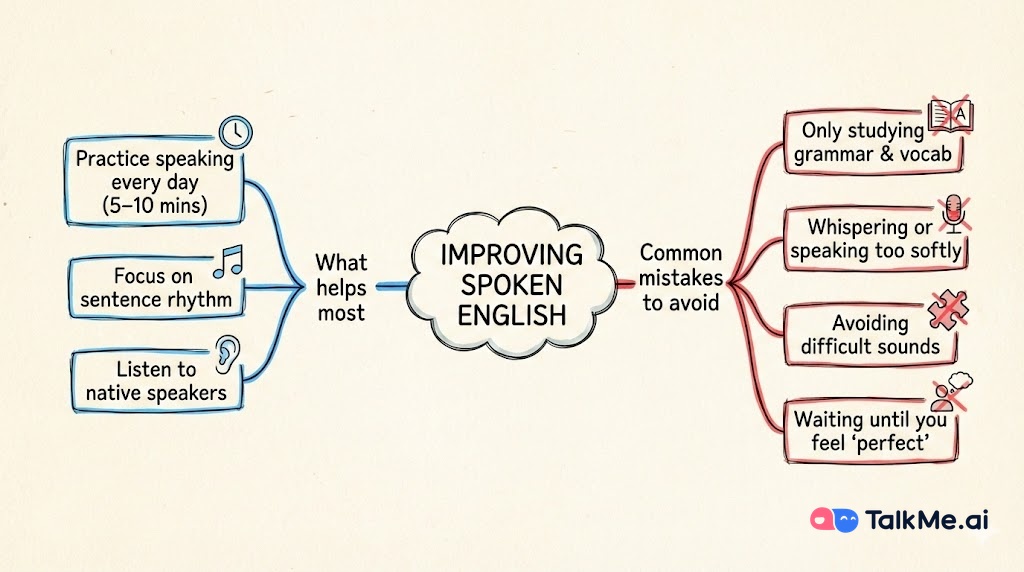
What helps most
Practice speaking every day, even for 5–10 minutes.
Focus on sentence rhythm, not just individual words.
Listen to native speakers in real conversations.
Common mistakes to avoid
Only studying grammar and vocabulary
Whispering or speaking too softly while practicing
Avoiding difficult sounds
Waiting until you feel “perfect” to start speaking
Practical tip
Use a tool that gives instant pronunciation feedback. Apps like TalkMe let you practice anytime without the pressure of speaking to a real person.
FAQ
How do I know if my pronunciation is correct?
You need feedback. Recording yourself or using an AI speaking app can help you compare your pronunciation with native speech.
Is accent reduction necessary?
Not always. Clear, understandable pronunciation is more important than sounding completely native.
How long does it take to improve pronunciation?
With daily speaking practice and feedback, many learners notice improvement within a few weeks.
Can I fix pronunciation without a teacher?
Yes. AI conversation tools like TalkMe provide real-time feedback and structured speaking practice without needing a live tutor.
Key Takeaways
Doubting your pronunciation is very common.
Lack of feedback is the main cause.
Daily speaking practice is essential.
Real-time correction speeds up improvement.
Contextual conversations build natural rhythm.
If you want to stop guessing and start speaking with confidence, try practicing with an AI tutor.
Download TalkMe from the App Store or Google Play and start improving your pronunciation today.




Comments
No comments yet.
Leave a Comment