

Learning a new language can feel frustrating when your sentences sound “off,” even though you know the vocabulary. Many learners can name objects, form basic phrases, and recognize grammar patterns, yet still struggle to put words together in a way that sounds natural. This problem usually comes down to word order.
When word order doesn’t match how native speakers actually talk, your sentences may be technically correct but still sound awkward or confusing. Fixing this issue is one of the fastest ways to sound more fluent.
What “Natural Word Order” Really Means
Natural word order refers to how native speakers arrange words in real conversations. It’s not just about grammar rules; it’s about rhythm, emphasis, and patterns that feel instinctive to people who grew up with the language.
For example:
Even if the meaning is understandable, unnatural word order makes speech sound robotic or translated.
Why Learners Struggle With It
Most learners build sentences using the structure of their first language. This habit is natural, but it creates problems:
You translate word-for-word in your head
You rely too much on grammar rules
You rarely practice real conversations
You memorize vocabulary without context
As a result, your sentences may be correct on paper but unnatural in real life.
Where the Problem Usually Appears
Word order issues tend to show up in specific situations:
Questions: “You are going where?”
Adverbs: “I every day practice English.”
Time expressions: “Yesterday I to school went.”
Complex sentences: Mixing clauses in the wrong order
These mistakes don’t always block communication, but they make speech sound stiff or unnatural.
How to Fix Unnatural Word Order: A Step-by-Step Guide
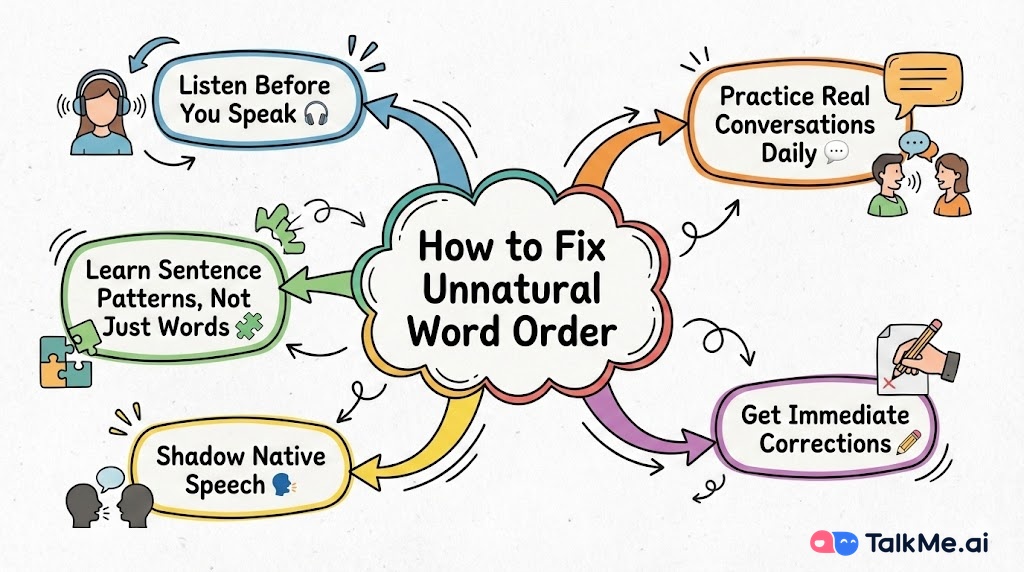
1. Listen Before You Speak 🎧
Pay attention to how native speakers arrange their sentences. Focus on full phrases instead of individual words.
Good sources:
Podcasts
Short videos
Everyday conversations
2. Learn Sentence Patterns, Not Just Words 🧩
Instead of memorizing isolated vocabulary, learn chunks:
“I’d like to…”
“Do you mind if…”
“It turns out that…”
These patterns help you produce natural sentences automatically.
3. Shadow Native Speech 🗣️
Shadowing means repeating what you hear immediately after a speaker.
Steps:
Play a short sentence
Repeat it aloud
Match rhythm and word order
This builds muscle memory for natural structure.
4. Practice Real Conversations Daily 💬
Natural word order develops through interaction, not just study.
Using an AI conversation app like TalkMe can help because it:
Simulates real-life situations
Adjusts to your level
Gives instant feedback
Lets you practice anytime
Instead of translating in your head, you respond naturally in context.
5. Get Immediate Corrections ✏️
If no one corrects you, unnatural patterns become habits.
You should:
Ask for feedback
Record your speech
Use tools that highlight unnatural phrasing
Apps with interactive AI tutors can point out word order issues during conversations.
Quick Reference: Natural vs Unnatural Patterns
This table works well as a quick visual reminder when practicing.
Tips, Advice, and Common Mistakes
What to do:
Focus on phrases, not individual words
Listen to natural conversations daily
Practice speaking more than translating
What to avoid:
Translating word-for-word from your native language
Memorizing long grammar rules without speaking
Overthinking sentence structure before speaking
A practical approach is to practice short, real-life dialogues regularly. Apps like TalkMe make this easier by simulating situations such as ordering food, asking for directions, or chatting with coworkers.
FAQ
Why do my sentences sound correct but still unnatural?
Because grammar rules don’t always reflect how native speakers actually talk. Natural speech uses patterns, shortcuts, and rhythm.
How long does it take to fix word order problems?
With daily speaking practice, many learners notice improvement in a few weeks.
Is grammar study enough?
No. Grammar helps, but natural word order develops through listening and speaking.
Can AI help with this problem?
Yes. AI conversation tools like TalkMe provide instant corrections and realistic dialogues, which help build natural sentence patterns faster.
Key Takeaways
Unnatural word order makes speech sound robotic
The main cause is translating from your first language
Listening, shadowing, and conversation practice fix the issue
Real-life dialogue practice is the fastest solution
If you want to sound more natural when speaking, start practicing conversations daily. Download TalkMe from the App Store or Google Play, and begin speaking with an AI tutor that helps you use natural word order from your very first session.




Comments
No comments yet.
Leave a Comment