

Many English learners know the words they want to say, but their sentences still sound choppy or awkward. You might jump from one idea to another without a clear link. The listener understands the basic meaning, but the message feels disconnected or unfinished.
This problem shows up in conversations, presentations, and even simple daily interactions. It’s not about vocabulary size—it’s about how your ideas move from one point to the next.
What it really means when ideas don’t connect
When ideas aren’t connected smoothly, speech or writing sounds like a list of separate statements instead of a logical flow. For example:
“I went to the store. It was raining. I forgot my umbrella. I bought milk.”
Each sentence is correct, but the connection between them is weak. Native speakers usually link these thoughts:
“I went to the store because I needed milk, but it was raining and I’d forgotten my umbrella.”
The second version sounds more natural because the ideas are logically tied together.
Where the problem usually starts
This issue often comes from three common causes:
Translating directly from your native language
Sentence logic doesn’t always transfer smoothly between languages.Overusing simple sentence patterns
Many learners rely only on “Subject + Verb + Object” structures.Lack of linking words and transitions
Without connectors, speech sounds like disconnected pieces.
How to connect ideas smoothly: a step-by-step guide
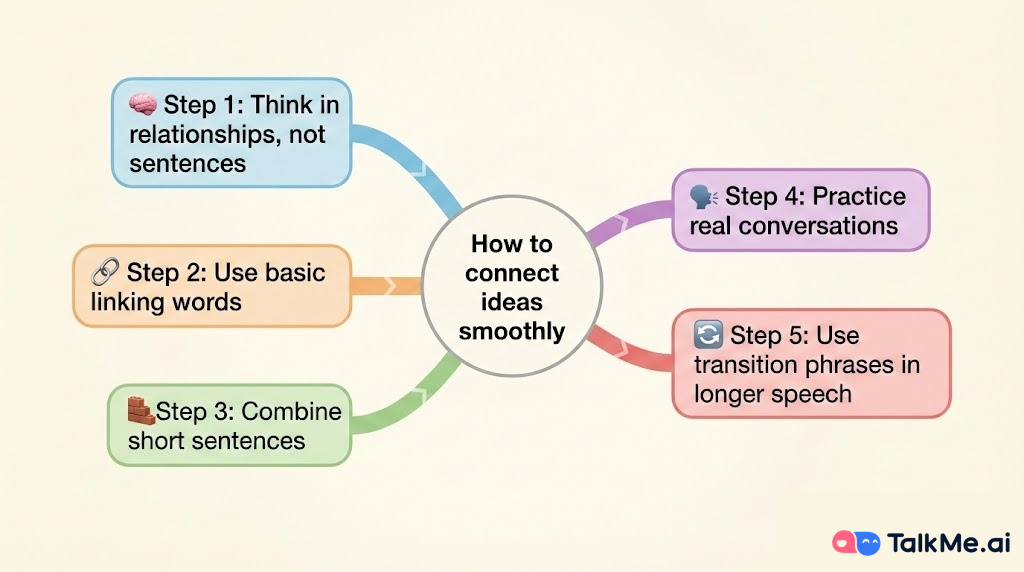
🧠 Step 1: Think in relationships, not sentences
Before speaking, ask yourself:
Is this idea a reason?
A result?
A contrast?
An example?
Once you know the relationship, choosing the right connector becomes easier.
🔗 Step 2: Use basic linking words
Start with common connectors:
Example:
“I was tired, so I went to bed early.”
🧱 Step 3: Combine short sentences
Take two simple sentences and join them.
Before:
“She studied hard. She passed the exam.”
After:
“She studied hard, so she passed the exam.”
Practice this daily with your own sentences.
🗣️ Step 4: Practice real conversations
Connecting ideas smoothly is easier when you practice in real contexts. Tools like TalkMe AI let you role-play everyday situations with an AI tutor, so you naturally practice linking thoughts during conversations instead of memorizing isolated sentences.
🔄 Step 5: Use transition phrases in longer speech
For longer answers or presentations, try phrases like:
“First of all…”
“On the other hand…”
“For example…”
“As a result…”
These guide the listener through your ideas.
Quick visual summary
Tips, practical advice, and common mistakes
Useful tips
Practice speaking in full thoughts, not single sentences.
Learn connectors in small groups (cause, contrast, result).
Record yourself and listen for pauses between ideas.
Common mistakes
Using too many connectors in one sentence.
“Because… so… therefore…” (choose one)
Starting every sentence with “and.”
Pausing too long between related ideas.
A practical shortcut
If you struggle to connect ideas in real time, conversation-based apps like TalkMe AI help you practice linking thoughts naturally. Instead of memorizing grammar rules, you respond to realistic scenarios and get used to how ideas flow in real speech.
FAQ
Why do my sentences sound correct but unnatural?
Because they’re grammatically right but logically disconnected. Native speakers expect ideas to flow smoothly.
How many linking words should I learn first?
Start with 10–15 common ones: and, but, because, so, although, however, therefore, also, then, for example, etc.
Is this problem more common in speaking or writing?
It appears in both, but it’s more noticeable in speaking because listeners expect immediate clarity.
Can an AI language app really help with this?
Yes, especially if it focuses on conversation. Apps like TalkMe simulate real-life situations, so you practice linking ideas while speaking instead of studying connectors in isolation.
Key takeaways
Smooth communication depends on how ideas connect, not just vocabulary.
Think about relationships: cause, contrast, result, or addition.
Use simple connectors first, then expand your range.
Practice in real conversations to build natural flow.
If you want a faster way to improve your speaking flow, try practicing with TalkMe AI. You can find it by searching “TalkMe” on the App Store or Google Play and start connecting your ideas more naturally in real conversations.




Comments
No comments yet.
Leave a Comment