

English learners often understand vocabulary and grammar, yet still struggle to be understood. The problem usually isn’t what they say—it’s how they say it. Many words sound almost identical, and small pronunciation differences can completely change meaning. That’s why mixing up similar sounds is one of the most common barriers to clear communication.
Why Similar Sounds Cause So Many Problems
English contains many sound pairs that don’t exist in other languages. For example:
/l/ vs. /r/ (light vs. right)
/b/ vs. /v/ (boat vs. vote)
/ɪ/ vs. /iː/ (ship vs. sheep)
When your ears aren’t trained to hear the difference, your mouth won’t produce it correctly either. This leads to confusion in everyday conversations, job interviews, and even simple tasks like ordering food.
Where the Confusion Usually Happens
Most learners mix up similar sounds because of three key issues:
Native language interference
Your first language may not include certain English sounds.Lack of listening training
If you can’t hear the difference, you can’t reproduce it.Limited speaking practice
Reading and writing don’t train your mouth muscles the way real conversation does.
How to Stop Mixing Up Similar Sounds: Step-by-Step Guide
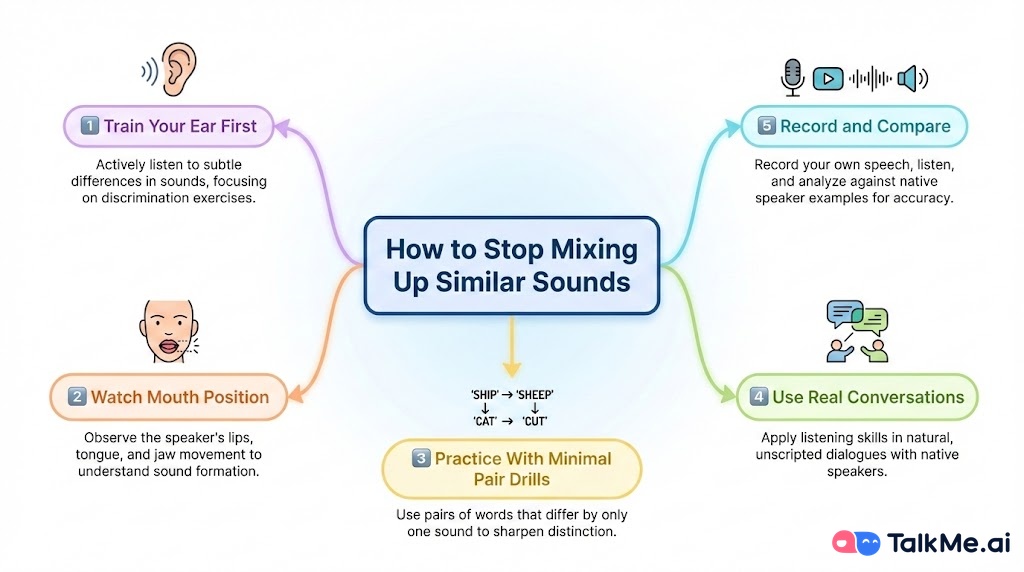
1️⃣ Train Your Ear First
Before speaking, you must learn to hear the difference.
Listen to minimal pairs (e.g., ship vs. sheep).
Repeat after recordings.
Focus on one sound pair at a time.
2️⃣ Watch Mouth Position
Pronunciation is physical.
Observe tongue and lip placement.
Use a mirror while practicing.
Compare how your mouth moves for each sound.
3️⃣ Practice With Minimal Pair Drills
Minimal pairs are words that differ by just one sound.
Practice them in:
Single words
Short phrases
Full sentences
4️⃣ Use Real Conversations
Drills help, but real speech builds confidence.
Practice role-play situations.
Simulate daily conversations.
Get feedback on your pronunciation.
Apps like TalkMe provide lifelike AI conversations that adapt to your level and help you practice these tricky sound differences in realistic scenarios.
5️⃣ Record and Compare
Self-feedback is powerful.
Record yourself saying minimal pairs.
Compare with native speaker audio.
Note where sounds differ.
Repeat the process until the difference becomes natural.
Quick Reference: Common Confusing Sound Pairs
This table works well as a quick daily practice checklist.
Practical Tips and Common Mistakes
What helps most:
Focus on one sound pair per week.
Practice daily for 5–10 minutes.
Use conversation tools that give instant feedback, such as TalkMe.
Common mistakes to avoid:
Practicing too many sounds at once.
Only reading instead of speaking.
Ignoring listening practice.
FAQ
Why do I keep mixing up the same sounds?
Because your brain hasn’t fully learned to distinguish them yet. Consistent listening and speaking practice is required.
How long does it take to fix pronunciation issues?
Many learners notice improvement in a few weeks with daily practice.
Is it better to practice alone or with someone?
Both help. Solo drills build accuracy, while conversation builds fluency. AI conversation tools like TalkMe can combine both.
Do I need a perfect accent?
No. The goal is clarity, not perfection.
Key Takeaways
Similar sound confusion is normal for English learners.
Listening training comes before speaking accuracy.
Minimal pairs are the most effective practice tool.
Real conversations turn drills into real skills.
If you want to practice these sounds in realistic, interactive conversations, try TalkMe. Just search TalkMe on the App Store or Google Play and start practicing with your AI language tutor today.




Comments
No comments yet.
Leave a Comment