

English pronunciation isn’t only about individual sounds. Many learners know the right vocabulary and grammar, yet still feel misunderstood in real conversations. The main reason is often word stress—the rhythm and emphasis inside words.
When stress is placed incorrectly, even a familiar word can become difficult for listeners to recognize. Improving this one skill can make your speech clearer, more confident, and easier to follow.
What “word stress” actually means
In English, most multi-syllable words have one syllable that is stronger than the others. That stressed syllable is:
Louder
Slightly longer
Higher in pitch
Clearer in vowel sound
For example:
Stress patterns often change depending on the word form, and that’s what makes English pronunciation tricky.
Where most learners run into trouble
Many languages use a more even rhythm, where each syllable has similar weight. English is different—it’s a stress-timed language.
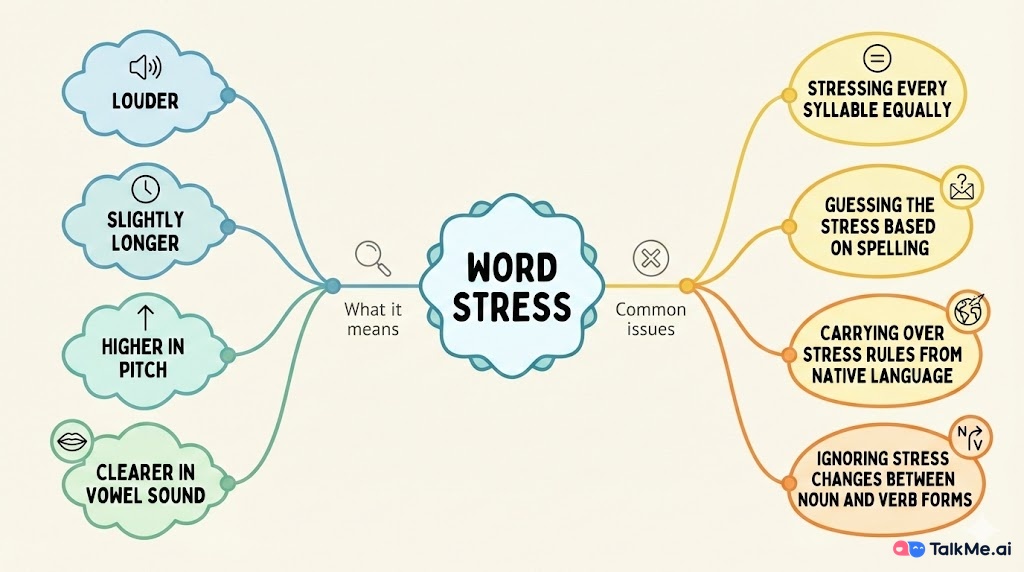
Common issues include:
Stressing every syllable equally
Guessing the stress based on spelling
Carrying over stress rules from the native language
Ignoring stress changes between noun and verb forms
When stress is wrong:
“PREsent” (noun) may sound like “preSENT” (verb)
“imPORTant” may sound like a different word altogether
Listeners may hesitate or ask for repetition—not because your vocabulary is wrong, but because the rhythm is off.
How to master word stress: a step-by-step guide
1) Learn the basic stress patterns
Start with the most common rules:
Two-syllable nouns: stress the first syllable
TAble, WINdow, DOCtor
Two-syllable verbs: stress the second syllable
reLAX, deCIDE, arRIVE
These aren’t perfect rules, but they cover many everyday words.
2) Mark stress when you learn new vocabulary
Instead of writing:
computer
Write:
comPUter
This small habit trains your brain to store the rhythm along with the meaning.
3) Listen before you speak
Whenever you learn a new word:
Listen to a native speaker.
Notice which syllable is strongest.
Repeat it aloud three times.
Short, frequent repetition works better than long, irregular practice.
4) Use sentence-level practice
Word stress becomes clearer in full sentences.
Example:
I bought a new COMputer yesterday.
She needs to reLAX after work.
Practicing inside sentences helps you develop natural rhythm.
5) Practice in realistic conversations
This is where many learners struggle: they know the rule, but forget it while speaking.
Tools like TalkMe AI help here because they simulate real conversations and react to your pronunciation. Instead of repeating isolated words, you practice stress patterns while ordering food, attending meetings, or making small talk—situations where rhythm matters.
Practical tips, useful habits, and common mistakes
Tips that actually work
Record yourself and compare with native audio.
Exaggerate stress during practice.
Practice in short bursts (5–10 minutes daily).
Focus on high-frequency words first.
Common mistakes to avoid
Memorizing spelling instead of sound.
Speaking too fast before mastering stress.
Ignoring stress changes in word families.
Practicing only single words without sentences.
If you’re using an app like TalkMe, choose role-play scenarios that match your daily life. You’ll naturally repeat the same high-frequency words, which reinforces correct stress.
Quick reference chart: key ideas at a glance
FAQ
Why is word stress so important in English?
Because English relies heavily on rhythm. If stress is wrong, listeners may not recognize the word even if every sound is correct.
Are there fixed rules for word stress?
There are patterns, but many exceptions. The safest approach is to learn stress along with each new word.
How long does it take to improve word stress?
With daily focused practice, many learners notice clearer pronunciation in a few weeks.
Can an app really help with stress?
Yes—especially apps that simulate real conversations. For example, TalkMe provides interactive dialogues where you practice pronunciation in realistic scenarios instead of isolated drills.
Take the next step
Clear word stress can transform how your English sounds. It makes you easier to understand, more confident in conversations, and closer to natural speech.
Start by:
Marking stress in new words.
Practicing short sentences daily.
Using real-life speaking scenarios.
If you want structured conversation practice, try TalkMe AI. It lets you speak with a lifelike AI tutor, practice realistic situations, and adjust difficulty to your level.
Search “TalkMe” on the App Store or Google Play to download and start practicing today.




Comments
No comments yet.
Leave a Comment