

Is your progress stalled because your pronunciation errors have become deep-rooted habits? This guide reveals the specific retraining techniques to break the cycle of "fossilized" errors and gain immediate clarity.
Have you been studying English for years, possess a strong vocabulary, and understand complex grammar, yet native speakers still struggle to understand you? This is the classic trap of fossilization. You speak fluently, but your errors are ingrained.
I have coached thousands of professionals who feel embarrassed because they still make the same mistakes they made as beginners. You are not alone, and this does not mean you lack talent. It simply means your muscle memory has taken over. This article will provide you with a scientifically backed roadmap to rewire your brain and mouth muscles, transforming your spoken English from "understandable" to "impressive."
What is Long-term Uncorrected Pronunciation?
Long-term uncorrected pronunciation refers to "fossilized" phonological errors where incorrect sounds become automatic muscle memory due to a lack of early feedback. Addressing this immediately boosts your listener's comprehension and significantly elevates your professional authority.
The Reality of "Fossilized" Errors
Many advanced learners hit a plateau where they stop improving. You might be speaking English every day, but without specific correction, you are simply reinforcing long-term uncorrected pronunciation habits. It feels frustrating to put in the effort but see no change in how people react to your voice.
The Path to Clarity
I understand how disheartening it is to repeat yourself constantly. However, neuroplasticity proves that adults can retrain their neuromuscular pathways. In this guide, we will move beyond standard "repeat after me" drills. You will learn to audit your own speech, use technology for feedback, and master the physical mechanics of English to finally break these old habits.
Key Takeaways
It's Physical: Pronunciation is a motor skill, like playing a sport.
Audit First: You cannot fix errors you cannot hear.
Feedback is King: Uncorrected practice makes permanent, not perfect.
How to Fix Long-term Uncorrected Pronunciation: A Step-by-Step Guide
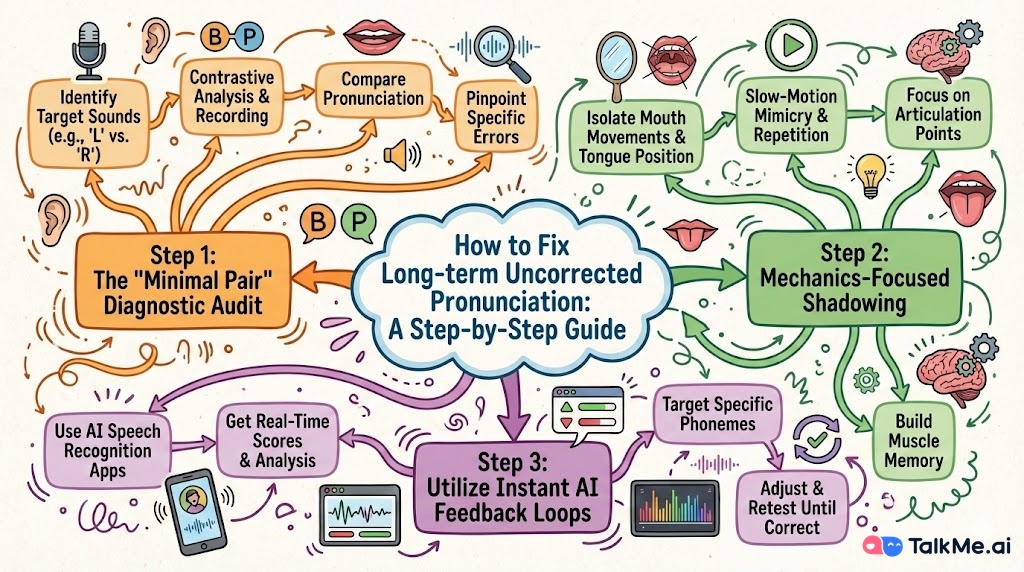
To break habits that have existed for years, you need a disruptive approach. Passive listening is not enough; you need active reconstruction.
Step 1: The "Minimal Pair" Diagnostic Audit
How to do it:
Record yourself reading a list of "minimal pairs"—words that differ by only one sound (e.g., Ship/Sheep, Bad/Bed, Think/Sink). Listen to the recording and compare it to a native speaker's audio.
Why it works:
Long-term uncorrected pronunciation often stems from "categorical perception," where your brain maps foreign sounds to the closest sound in your native language. Recording yourself forces your brain to hear the objective reality of your speech, bridging the gap between what you think you are saying and what you actually say.
Step 2: Mechanics-Focused Shadowing
How to do it:
Choose a short clip (30 seconds) of a native speaker. Stand in front of a mirror. Do not just mimic the sound; mimic the movement. Watch how their lips round, how wide their jaw opens, and where their tongue is placed. Replicate these physical movements exaggeratedly.
Why it works:
English requires different facial muscles than your native language. By focusing on the mechanics (the "gymnastics" of the mouth), you override the old muscle memory that causes your pronunciation errors.
Step 3: Utilize Instant AI Feedback Loops
How to do it:
You cannot always rely on a human tutor to catch every slip-up in real-time. This is where AI tools shine. You can use an app like Talkme, which offers a safe environment to practice scenarios and provides immediate analysis of your pronunciation accuracy.
Why it works:
The critical factor in fixing fossilized errors is the speed of the correction. If you correct a sound seconds after making it, the brain rewiring process is significantly faster than if you are corrected days later.
Concrete Advice: Avoid These 3 Common Mistakes
As an expert in linguistic correction, I often see students waste time on the wrong things. To effectively cure long-term uncorrected pronunciation, avoid these traps.
Mistake 1: Prioritizing Speed Over Accuracy
The Trap: Thinking that speaking fast equals fluency.
My Advice: Slow down to 70% of your normal speed. When you speak too fast, your mouth defaults to its old, incorrect muscle memory. You must speak slowly enough to consciously control your tongue and lips.
Mistake 2: Obsessing over Individual Sounds while Ignoring Rhythm
The Trap: Perfecting the "R" sound but sounding robotic.
My Experience: I once worked with a software engineer who had perfect diction but was hard to understand because he stressed every syllable equally. English is a stress-timed language.
The Fix: Focus on Prosody—the music of the language. Learn which words to emphasize (content words) and which to swallow (function words). Often, fixing your rhythm hides minor sound errors.
Frequently Asked Questions (FAQ)
Q1: Is it too late to fix my pronunciation if I've been speaking this way for 20 years?
A: Absolutely not. While it requires more conscious effort than it does for a child, your muscle memory is plastic. With high-intensity, focused practice (not just casual conversation), you can rewrite these patterns.
Q2: How long does it take to see results?
A: If you practice focused shadowing and self-recording for 15 minutes a day, you will hear a noticeable difference in your recording within 3 to 4 weeks.
Conclusion
Overcoming long-term uncorrected pronunciation is not about erasing your identity; it is about removing the friction between your ideas and your listener's ear.
Audit: Record yourself to identify the gap between perception and reality.
Mechanics: Treat pronunciation like a sport—train your mouth muscles, not just your ears.
Rhythm: Focus on the music of the sentence to sound more natural immediately.
You have the tools and the roadmap. Do not let old habits dictate your future potential. Start by recording your voice today—you might be surprised by what you hear, and that is the first step toward mastery.
Ready to transform your English? Stop guessing if you are saying it right. Get the instant correction you need to finally break old habits. Simply search for "TalkMe" on the App Store or Google Play and download it today. Your journey to clarity starts here.




Comments
No comments yet.
Leave a Comment