

You’ve studied vocabulary lists, watched videos, and maybe even practiced with native speakers. But somehow, you still trip over the same words again and again. It’s frustrating—especially when you know the meaning, but your mouth just won’t cooperate.
If this sounds familiar, you’re not alone. Many language learners repeatedly mispronounce certain words, even after months or years of study. The good news: this usually isn’t a talent issue. It’s a training issue—and it can be fixed.
Why the Same Words Keep Causing Trouble
When you keep mispronouncing the same words, it usually comes down to habit and memory. Your brain stores not just the meaning of a word, but also the sound pattern you first learned.
If you learned the pronunciation incorrectly, that version becomes your default. Every time you repeat it, you reinforce the mistake.
Common reasons include:
Learning words from text instead of audio
Translating sounds from your native language
Never receiving correction
Practicing silently instead of speaking aloud
Over time, these small errors turn into automatic habits.
Where the Problem Usually Starts
Most pronunciation problems begin at the moment of first exposure to a word. If you:
Guess the pronunciation
Hear it only once
Learn it from a non-native source
Memorize spelling instead of sound
…then your brain locks in an incorrect version.
Later, even when you hear the correct pronunciation, your mouth still follows the old pattern. That’s why some words feel “impossible” to fix.
How to Stop Mispronouncing the Same Words: A Step-by-Step Guide
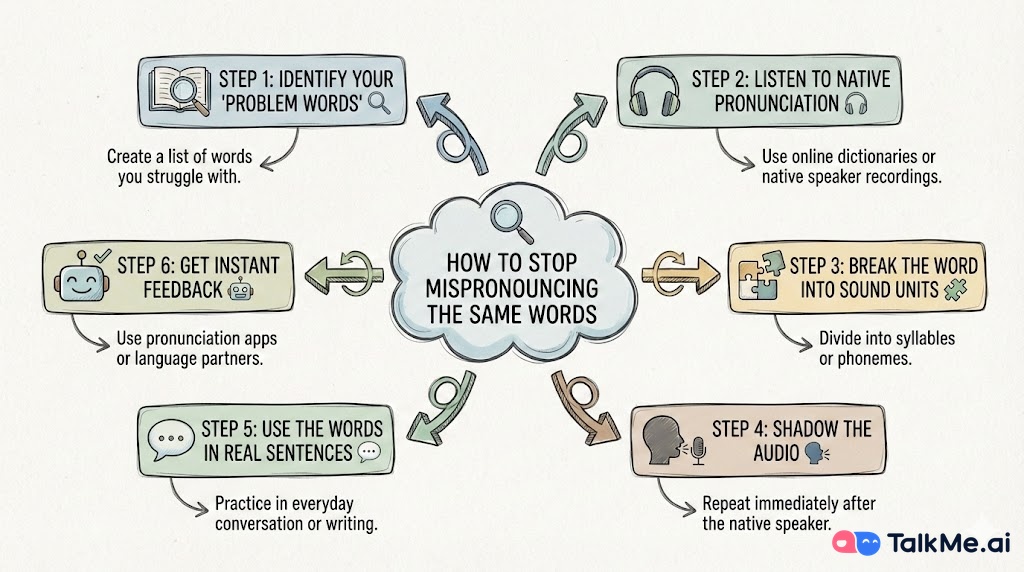
Step 1: Identify Your “Problem Words” 🔎
Write down 5–10 words you frequently mispronounce.
These are usually:
Words people correct you on
Words you avoid saying
Words you hesitate before speaking
Focusing on a small set helps your brain retrain faster.
Step 2: Listen to Native Pronunciation 🎧
Search for each word in a reliable dictionary or pronunciation tool.
Listen multiple times, not just once.
Pay attention to:
Stress patterns
Vowel length
Connected sounds
Step 3: Break the Word Into Sound Units 🧩
Instead of reading the whole word, split it into parts.
For example:
Your goal is to match real speech, not spelling.
Step 4: Shadow the Audio 🗣️
Play the pronunciation and repeat immediately after it.
Do this:
5–10 times per word
At natural speed
Out loud
This trains your mouth muscles, not just your memory.
Step 5: Use the Words in Real Sentences 💬
Practice each word inside a short sentence.
For example:
“I feel comfortable here.”
“She bought fresh vegetables.”
Speaking in context helps the pronunciation stick.
Step 6: Get Instant Feedback 🤖
Many learners repeat mistakes because no one corrects them consistently.
Using a speaking app with real-time feedback—like TalkMe—can help you:
Detect mispronunciations
Practice realistic conversations
Correct mistakes before they become habits
Short, daily speaking sessions are often more effective than long study sessions.
Quick Comparison: Wrong vs. Effective Practice
Practical Tips and Common Mistakes
What helps:
Practice out loud every day, even for 5 minutes
Focus on stress and rhythm, not just individual sounds
Record yourself and compare with native audio
What to avoid:
Relying only on reading
Practicing silently
Trying to fix too many words at once
Ignoring feedback
Some learners find it easier to practice consistently with an AI speaking partner, especially when they don’t have access to native speakers. Tools like TalkMe provide structured speaking scenarios and instant corrections, which can prevent repeated pronunciation errors.
FAQ
Why do I keep mispronouncing the same words?
Because your brain memorized the wrong sound pattern early on. Repetition without correction strengthens the mistake.
How long does it take to fix a mispronounced word?
With daily focused practice, many learners can correct a word in 3–7 days.
Is listening enough to fix pronunciation?
No. You must speak the word repeatedly. Pronunciation is a physical skill, not just mental knowledge.
Can an AI app really help with pronunciation?
Yes. Apps like TalkMe simulate real conversations and provide immediate feedback, which helps correct errors before they become habits.
Key Takeaways
Repeated mispronunciations come from reinforced habits.
Most problems start when a word is first learned incorrectly.
Focused, spoken practice is the fastest way to fix problem words.
Feedback is essential to prevent repeating the same mistakes.
If you want consistent speaking practice without waiting for a language partner, try using an AI tutor. Search for TalkMe on the App Store or Google Play to start practicing pronunciation in real conversations today.




Comments
No comments yet.
Leave a Comment