

Learning a new language isn’t just about vocabulary and grammar. The way you sound—your rhythm, stress, and melody—shapes how clearly people understand you. Many learners notice that even when they know the right words, conversations still feel awkward or misunderstood. That’s usually a matter of accent and intonation, not intelligence or effort.
What “Perfect” Accent and Intonation Really Mean
A “perfect” accent doesn’t mean sounding exactly like a native speaker. In most cases, it means being clear, natural, and easy to understand. Intonation, on the other hand, is the musical pattern of speech—how your voice rises and falls to show emotion, emphasis, or meaning.
For example:
“You’re going.” (statement)
“You’re going?” (surprise or question)
Same words, different intonation, different meaning.
Why Learners Struggle With Accent and Intonation
Many learners face similar problems:
They focus only on grammar and vocabulary.
They learn from textbooks but rarely hear natural speech.
They translate from their native language while speaking.
They don’t get feedback on pronunciation.
Without regular listening and speaking practice, accent and intonation rarely improve on their own.
How to Improve Accent and Intonation: Step-by-Step Guide
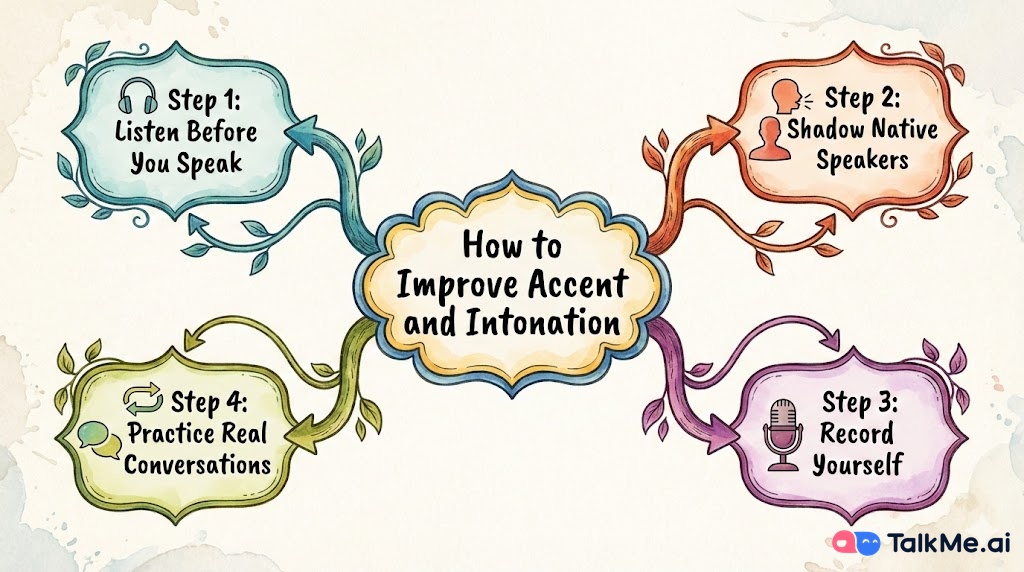
🎧 Step 1: Listen Before You Speak
Spend time listening to natural speech—podcasts, interviews, or conversations. Pay attention to rhythm and tone, not just words.
What to focus on:
Where the speaker pauses
Which words sound stronger
How sentences rise or fall
🗣️ Step 2: Shadow Native Speakers
Shadowing means repeating what you hear almost immediately, copying rhythm and tone.
How to do it:
Play a short audio clip.
Repeat it in real time.
Focus on melody, not perfection.
This builds natural flow and muscle memory.
🎙️ Step 3: Record Yourself
Most learners don’t realize how they sound until they hear a recording.
Try this:
Read a short paragraph aloud.
Record it on your phone.
Compare it with a native version.
Notice differences in:
Speed
Stress
Tone changes
🔁 Step 4: Practice Real Conversations
Accent improves fastest in real dialogue. Simulated conversations can be helpful, especially when you don’t have access to native speakers.
Apps like TalkMe provide lifelike AI conversations, role-play scenarios, and adaptive feedback so you can practice speaking naturally without pres
Flat vs. Natural Speech
Tips, Advice, and Common Mistakes
What works:
Listen daily, even 10–15 minutes.
Practice full sentences, not isolated words.
Imitate rhythm, not just pronunciation.
Common mistakes:
Trying to erase your accent completely.
Speaking too slowly to sound “correct.”
Ignoring intonation and focusing only on sounds.
A practical way to avoid these mistakes is to use tools that simulate real conversations and provide feedback, such as TalkMe, which adapts to your level and speaking style.
FAQ
Do I need a perfect accent to be understood?
No. Clear pronunciation and natural intonation matter more than sounding like a native speaker.
How long does it take to improve accent and intonation?
With daily practice, many learners notice changes in 4–8 weeks.
Is listening or speaking more important?
Both. Listening builds awareness; speaking builds muscle memory.
Can an app really help with accent?
Yes, especially if it includes interactive conversations and feedback. Tools like TalkMe simulate real-life scenarios so you can practice tone, rhythm, and stress naturally.
Key Takeaways
Accent is about clarity, not perfection.
Intonation changes meaning and emotion.
Daily listening and shadowing make a big difference.
Real conversations accelerate improvement.
If you want consistent speaking practice without the pressure of real-world mistakes, try an AI conversation partner. Search TalkMe on the App Store or Google Play and start practicing your accent and intonation today.




Comments
No comments yet.
Leave a Comment