

Learning a new language often starts with enthusiasm—and then hits a wall of grammar. Tenses, articles, irregular verbs, exceptions to the exceptions… it can feel like there are too many rules and none of them stick. If you’ve ever opened a grammar book and closed it five minutes later, you’re not alone.
Why Grammar Feels So Hard to Remember
Most learners are taught grammar as a collection of rules to memorize. You study charts, complete exercises, and try to recall the right structure when speaking. But real conversations don’t wait for you to check a rule.
Language isn’t a math formula. It’s a habit. When grammar is learned only from books, it often stays in the “theory” part of your brain instead of becoming something you can use naturally.
Where the Problem Actually Starts
Most grammar struggles come from three common issues:
Too much information at once: Long rule lists without real context
Not enough speaking practice: Knowing rules but not using them
Fear of making mistakes: Waiting to speak until everything is “perfect”
This leads to a cycle: you study more rules, feel more confused, and avoid speaking altogether.
How to Remember Grammar Without Memorizing Every Rule
Instead of forcing yourself to memorize dozens of rules, use this step-by-step approach.
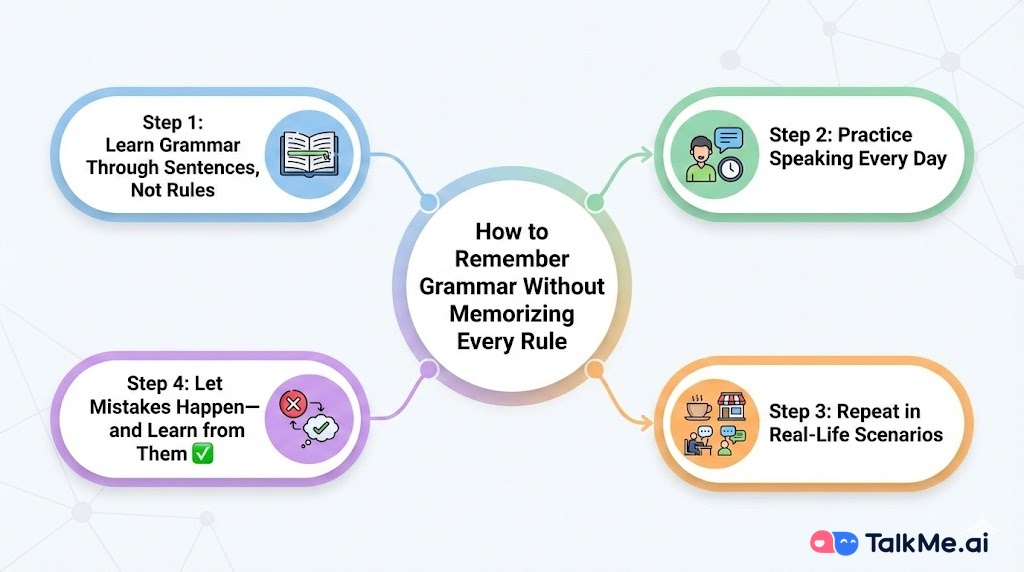
Step 1: Learn Grammar Through Sentences, Not Rules 📘
Instead of memorizing structures, focus on example sentences.
For example:
“I went to the store yesterday.”
“She is working now.”
“They have finished the project.”
Your brain remembers patterns better than abstract rules.
Step 2: Practice Speaking Every Day 🗣️
Grammar becomes natural when you use it repeatedly. Even short daily conversations help your brain build automatic patt
s at once. Pick one structure and use it in many sentences.
Example:
Today: past tense
Tomorrow: future tense
Next week: conditionals
Small, focused practice works better than cramming.
Step 3: Repeat in Real-Life Scenarios 🔁
Practice grammar in situations you actually face:
Ordering food
Introducing yourself
Talking about your day
Making plans
Apps with role-play features, like TalkMe, simulate these scenarios so you can practice grammar in context.
Step 4: Let Mistakes Happen—and Learn from Them ✅
Mistakes are part of the process. Each correction helps your brain adjust the pattern.
The goal isn’t perfect grammar. The goal is clear communication.
Quick Comparison: Memorizing Rules vs. Using Patterns
Helpful Tips and Common Mistakes
What helps:
Speak daily, even for 5–10 minutes
Learn grammar inside full sentences
Review patterns you actually use
Use conversation-based tools
Common mistakes:
Trying to memorize every rule at once
Avoiding speaking until grammar feels perfect
Studying without listening or speaking practice
Relying only on textbooks
If you want consistent speaking practice, an AI conversation app like TalkMe can fill the gap when you don’t have a partner.
Frequently Asked Questions
Do I really need to learn grammar rules?
Yes—but you don’t need to memorize all of them first. Start speaking, and learn rules as they become relevant.
How long does it take for grammar to feel natural?
With daily speaking practice, many learners notice improvement within a few weeks.
Is speaking practice better than grammar exercises?
They serve different purposes. Exercises help you understand structures, but speaking helps you use them automatically.
Can an AI tutor really help with grammar?
Yes. AI tutors can correct mistakes, repeat scenarios, and adapt to your level. Apps like TalkMe simulate real conversations, which helps grammar become more natural over time.
Key Takeaways
Grammar feels overwhelming when treated as pure memorization.
Real progress comes from using grammar in sentences and conversations.
Short, daily speaking practice is more effective than long grammar sessions.
Focus on patterns, not rule lists.
If you want a faster, more natural way to improve your grammar, try speaking practice with an AI tutor.
Search TalkMe on the App Store or Google Play and start practicing real conversations today.




Comments
No comments yet.
Leave a Comment