
Learning to understand real spoken English—and answer back without freezing—doesn’t have to cost money or require a native-speaking friend. With the right routine, you can build confidence quickly using simple, free resources and short daily practice.
What “free listening and speaking practice” really means (for beginners)
For beginners, “free” practice isn’t about doing everything perfectly. It’s about repeating small, realistic exercises that train two skills together:
Listening: catching keywords, rhythm, and common phrases
Speaking: responding out loud with clear, simple sentences
The fastest progress happens when you practice short listening + short speaking in the same session (even 10 minutes).
Why most beginners get stuck
Many learners do a lot of “input” (videos, podcasts, apps) but still can’t speak. Common reasons:
You listen passively (no pausing, no repeating, no checking understanding)
You don’t practice turn-taking (real conversations require responding fast)
Materials are too hard, so you miss most of the message
You’re afraid of making mistakes, so you avoid speaking out loud
You practice randomly instead of following a repeatable routine
How to practice listening and speaking for free: a step-by-step plan
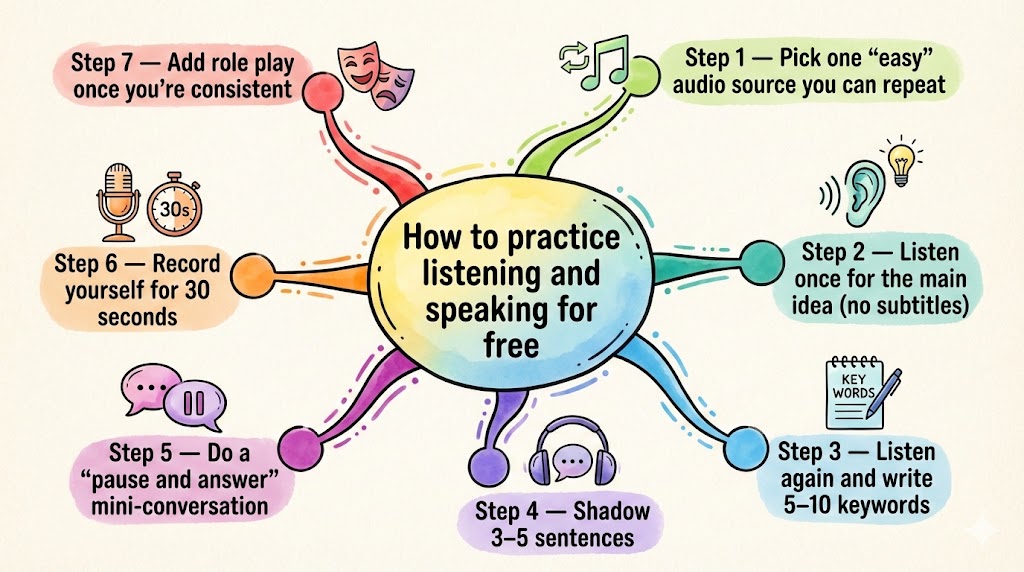
✅ Step 1 — Pick one “easy” audio source you can repeat
Choose content made for learners or slow, clear speech. Examples:
Beginner ESL videos (short dialogues)
Graded listening clips
Short daily news for learners
Rule: if you understand less than ~70%, it’s too hard for speaking practice.
✅ Step 2 — Listen once for the main idea (no subtitles)
Don’t stop. Just try to answer:
Who is speaking?
Where are they?
What is happening?
✅ Step 3 — Listen again and write 5–10 keywords 📝
Only write keywords, not full sentences. This trains real listening without overwhelming you.
✅ Step 4 — Shadow 3–5 sentences 🎧
Shadowing = listen and speak at the same time (or right after). Do short lines only. Focus on rhythm, not perfection.
✅ Step 5 — Do a “pause and answer” mini-conversation 🗣️
Turn listening into speaking:
Play one line (a question or prompt)
Pause
Answer with one simple sentence
Play the model answer (if available) and compare
This is the missing bridge for most beginners.
✅ Step 6 — Record yourself for 30 seconds 🎙️
Use your phone voice recorder. Talk about:
what you heard
your opinion (even one sentence)
a similar experience
Listening improves faster when your mouth is involved.
✅ Step 7 — Add role play once you’re consistent 🎭
When you can handle short dialogues, start role play (ordering coffee, asking directions, introducing yourself). This is where an app like TalkMe can help: it simulates real-life scenarios with an AI tutor, adapts to your level, and lets you practice conversation without pressure.
Quick chart: best free practice options (and what they’re good for)
Tips, practical advice, and common mistakes
What works well
Keep sessions short (10–15 minutes daily beats 1 hour once a week)
Use the same audio for 3 days to notice real improvement
Prepare starter responses:
“I think…”
“I don’t understand.”
“Can you repeat, please?”
Common mistakes to avoid
Only listening and calling it “speaking practice”
Using content that’s too hard (fast podcasts, movies without support)
Memorizing scripts without practicing real responses
Waiting to “feel ready” before speaking—readiness comes after repetition
A simple weekly structure
Mon–Wed: repeat one short dialogue (Steps 1–6)
Thu–Fri: new dialogue + role play (Step 7)
Weekend: review your recordings and repeat your weakest lin
/
FAQ
How long should beginners practice each day?
Aim for 10–20 minutes. Consistency matters more than duration, especially when building speaking confidence.
What if I can’t understand most of the audio?
Switch to easier material or slow it down. For speaking practice, understanding about 70–90% is ideal.
Is it okay to practice speaking alone?
Yes. Speaking alone (shadowing, recording, role play) builds the muscle memory you need before real conversations.
How can I practice conversation if I don’t have a partner?
Use role-play prompts, record Q&A, or try an AI tutor. TalkMe is designed for lifelike conversation practice with custom scenarios, so beginners can rehearse real situations without awkwardness.
Will my accent improve with free practice?
It can—especially with shadowing and repeating short lines. Focus on rhythm and clarity first; perfect pronunciation comes later.
Key takeaways (and what to do next)
Combine listening + speaking in the same short session
Repeat the same easy audio for several days
Use shadowing, pause-and-answer, and 30-second recordings to improve faster
Add role play to prepare for real conversations
If you want an easier way to do role plays and realistic dialogues whenever you have a few minutes, download TalkMe. Search “TalkMe” on the App Store or Google Play, pick a beginner scenario, and start practicing today.