

Speaking a new language can feel smooth during practice sessions, but the moment you enter a real conversation, everything changes. You know the rules. You’ve memorized the tenses. You’ve done the exercises. Yet when someone asks you a simple question, your mind goes blank.
This common experience frustrates millions of learners, and it has little to do with intelligence or effort. It’s a natural gap between knowing grammar and using it under pressure.
Why Grammar Disappears in Real Situations
In controlled environments—classrooms, apps, or textbooks—you have time to think. You can pause, check rules, or correct yourself. Real conversations don’t work like that.
Three key factors cause this disconnect:
Time pressure: Conversations move quickly.
Cognitive overload: You must think about meaning, vocabulary, pronunciation, and grammar at once.
Lack of context-based practice: Most learners study rules without real-life scenarios.
Your brain may know the grammar, but it hasn’t learned to apply it automatically.
Where the Problem Usually Starts
Many learners follow a familiar path:
This gap happens because grammar knowledge stays in conscious memory instead of becoming automatic speech patterns.
How to Stop Forgetting Grammar in Conversations
Follow these practical steps to make grammar stick when it matters most.
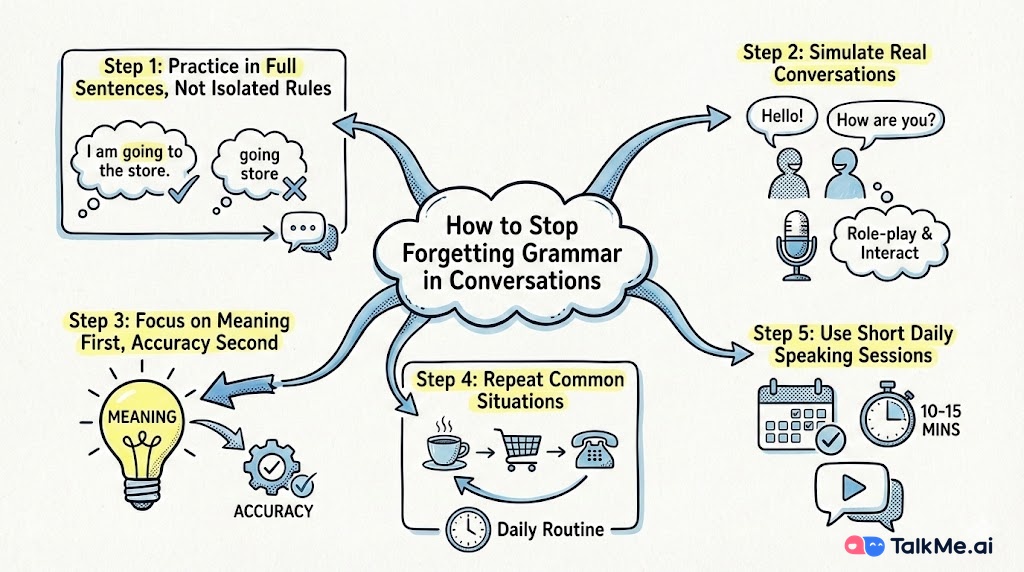
Step 1: Practice in Full Sentences, Not Isolated Rules
Instead of memorizing “past tense = verb + ed,” practice complete thoughts:
“I watched a movie yesterday.”
“She called me last night.”
Your brain remembers patterns, not formulas.
Step 2: Simulate Real Conversations
Grammar becomes automatic when used in realistic contexts.
For example:
Ordering food
Asking for directions
Talking about your weekend
Apps like TalkMe are designed for this type of practice. Its AI tutor creates lifelike scenarios and adapts conversations to your level, so grammar becomes part of natural speech instead of a memorized rule.
Step 3: Focus on Meaning First, Accuracy Second
When speaking:
Say what you want to say.
Let the conversation flow.
Notice mistakes afterward.
Fluency builds confidence, and confidence helps grammar surface naturally.
Step 4: Repeat Common Situations
Repetition in context builds automatic responses.
Practice the same scenarios:
Introducing yourself
Describing your day
Making small talk
After enough repetition, grammar becomes instinctive.
Step 5: Use Short Daily Speaking Sessions
Consistency matters more than long study sessions.
10–15 minutes of speaking daily
Realistic dialogue, not just drills
Immediate feedback
This keeps grammar active in your speaking memory.
Quick Visual Summary
Practical Tips and Common Mistakes
What helps:
Speak every day, even for a few minutes.
Use scenario-based practice instead of only textbooks.
Listen to your own recordings.
What to avoid:
Memorizing long grammar charts without speaking.
Waiting until you feel “perfect” before talking.
Translating every sentence in your head.
A conversational app like TalkMe can help here, since it provides structured scenarios and immediate responses without the pressure of real people.
FAQ
Why do I forget grammar when speaking but not when writing?
Writing gives you time to think and correct yourself. Speaking requires instant responses, which rely on automatic patterns.
Should I stop studying grammar rules?
No. Grammar is important, but it should support speaking practice, not replace it.
How long does it take for grammar to become automatic?
With daily speaking practice, many learners notice improvement within a few weeks.
Can AI conversation apps really help?
Yes, especially those designed for realistic dialogue. Tools like TalkMe create interactive scenarios so you can practice grammar in context instead of isolation.
Key Takeaways
Forgetting grammar in conversations is normal.
The problem comes from rule-based learning without real context.
Speaking practice in realistic situations builds automatic grammar.
Short, daily conversations are more effective than long study sessions.
If you want a simple way to practice real-life conversations anytime, try TalkMe AI. Just search “TalkMe” on the App Store or Google Play and start speaking with an AI tutor that adapts to your level.




Comments
No comments yet.
Leave a Comment