

Speaking English fluently is not just about grammar. It’s also about sounding natural in real conversations. Many learners unknowingly use expressions that are technically correct but feel old-fashioned, overly formal, or simply unnatural to native speakers. This can make conversations awkward or create misunderstandings.
If you’ve ever felt that your English sounds “off” even though it’s correct, the problem may be outdated or unnatural expressions.
What Are Outdated or Unnatural Expressions?
These are words or phrases that:
Were common decades ago but rarely used today
Sound too formal for casual conversations
Come directly from textbook translations
Don’t match how native speakers actually talk
For example:
Many learners pick up these phrases from old textbooks, formal business templates, or direct translations from their native language.
Where the Problem Usually Starts
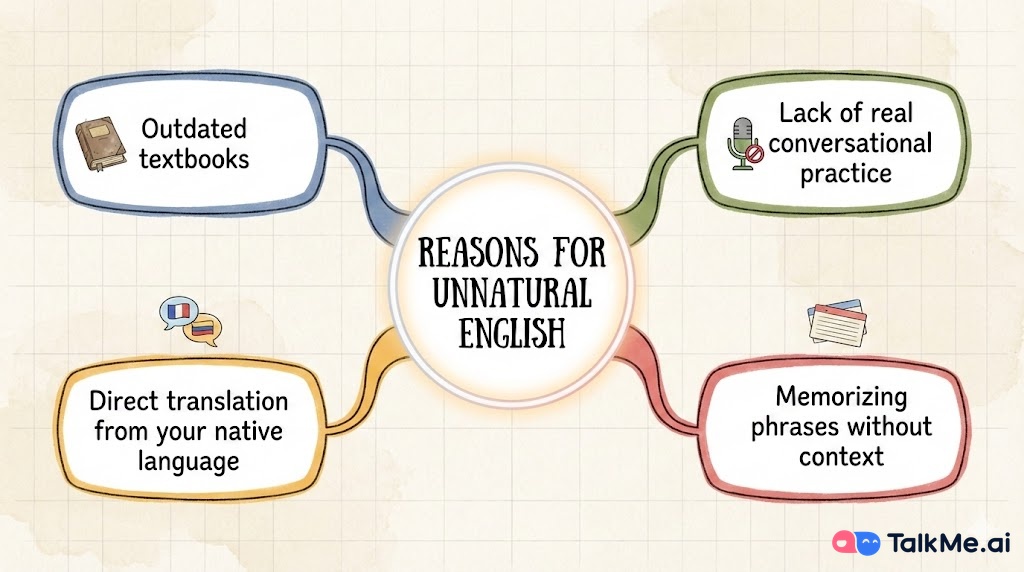
There are several common reasons learners end up using expressions that sound unnatural:
Outdated textbooks
Some learning materials focus on formal or old-style English.Direct translation from your native language
Certain phrases don’t exist in natural English conversation.Lack of real conversational practice
Without speaking to native speakers, it’s hard to notice what sounds natural.Memorizing phrases without context
A phrase may be correct in one situation but awkward in another.
How to Replace Unnatural Expressions: Step-by-Step
1️⃣ Notice When Something Feels Too Formal
If a sentence sounds like it belongs in a letter from the 1950s, it probably does.
Ask yourself:
Would someone say this in a café?
Would this sound normal in a text message?
2️⃣ Listen to Modern Spoken English
Watch:
YouTube interviews
Podcasts
TV shows or vlogs
Pay attention to:
Greetings
Short responses
Casual phrases
Real conversations reveal what people actually say, not just what textbooks teach.
3️⃣ Replace One Phrase at a Time
Don’t try to change everything at once. Focus on small upgrades.
Examples:
“I am very pleased to meet you.” → “Nice to meet you.”
“I must take my leave now.” → “I’ve got to go.”
“Please accept my gratitude.” → “Thanks!”
4️⃣ Practice with Realistic Conversations
The fastest way to fix unnatural phrasing is through conversation practice.
Apps like TalkMe simulate real-life scenarios with an AI tutor, letting you:
Practice everyday dialogues
Try role-play situations
Get responses that sound natural
Because the AI adapts to your level, you can experiment with modern expressions without pressure.
5️⃣ Record and Review Your Speech
Try this simple method:
Record yourself answering a daily question.
Listen back.
Replace anything that sounds too formal or unusual.
Over time, your speech becomes more natural and relaxed.
Tips, Advice, and Common Mistakes
Practical Tips
Learn phrases from real conversations, not just vocabulary lists.
Use contractions: “I’m,” “don’t,” “it’s.”
Keep sentences shorter and simpler.
Common Mistakes
Overusing formal phrases in casual situations.
Translating expressions directly from your first language.
Memorizing business English and using it everywhere.
A few minutes of daily speaking practice can quickly reveal which phrases sound natural and which don’t.
FAQ
Why do my sentences sound correct but still strange?
Because correctness and naturalness are different. Grammar may be right, but the expression may be outdated or too formal for the situation.
Is formal English wrong?
Not at all. Formal English is useful for emails, presentations, and official communication. The problem is using it in casual conversations.
How can I learn more natural expressions?
Expose yourself to modern spoken English and practice regularly. Tools like TalkMe help simulate everyday conversations so you can learn what people actually say.
How long does it take to sound more natural?
With daily speaking practice, many learners notice improvements in a few weeks.
Quick Comparison Chart
Key Takeaways
Natural English matters as much as correct grammar.
Many learners use expressions that sound outdated or too formal.
Small phrase upgrades can make a big difference.
Regular conversation practice is the fastest solution.
If you want to practice modern, natural English every day, download TalkMe and start speaking with an AI tutor that adapts to your level.
Search for TalkMe on the App Store or Google Play and try your first conversation today.




Comments
No comments yet.
Leave a Comment