

Many English learners study from different sources—YouTube, movies, textbooks, apps, and teachers from around the world. It’s normal to pick up vocabulary, pronunciation, and grammar from both British and American English without even noticing.
But when these forms get mixed in the same sentence or conversation, it can sound confusing or unnatural to native speakers. The good news: this is a very common issue, and it’s easy to fix once you understand how the differences work.
What does mixing British and American English mean?
Mixing happens when you use elements from both varieties of English without a consistent pattern. This can include:
Vocabulary: lorry vs. truck
Spelling: colour vs. color
Pronunciation: schedule pronounced two different ways
Grammar: I’ve just eaten vs. I just ate
For example:
“I just finished my homework and put it in the boot of the car.”
“Let’s meet in the city centre after I get some gas.”
Each sentence is understandable, but the combination sounds unusual because the styles come from different regions.
Where do these problems usually come from?
Most learners don’t mix varieties on purpose. It usually happens because:
1. Multiple learning sources
You might watch American TV shows, but your teacher uses British textbooks.
2. International environments
In global workplaces or schools, people from different countries use different forms of English.
3. Translation habits
Some words are learned from dictionaries without context, so learners don’t notice which variety they belong to.
How to stop mixing the two: a step-by-step guide
Step 1: Choose your primary English variety 🎯
Decide whether British or American English is more useful for your goals.
Studying in the UK → British English
Working with US companies → American English
No specific need → choose the one you hear most often
Consistency matters more than the choice itself.
Step 2: Build a “core vocabulary” list 🧠
Create a small list of commonly used words and learn them in one variety.
Focus on everyday words first. These create the biggest impression in conversation.
Step 3: Stick to one spelling system ✍️
Choose one spelling style and apply it everywhere:
Change your phone or computer language settings to match your chosen variety. This helps with automatic corrections.
Step 4: Practice speaking with consistent input 🎧
Use podcasts, videos, or conversation practice from one region.
For example:
American input: US podcasts, movies, or teachers
British input: BBC content, UK teachers, British podcasts
Apps like TalkMe can help you practice with a consistent accent and vocabulary style, since the AI tutor adapts to your level and chosen English variety.
Step 5: Correct mixing through real conversations 💬
The fastest way to notice mixing is through speaking practice.
When you talk regularly:
You hear your own patterns
You get corrections in context
You build natural habits
Role-play scenarios, job interviews, or casual conversations help reinforce one consistent style.
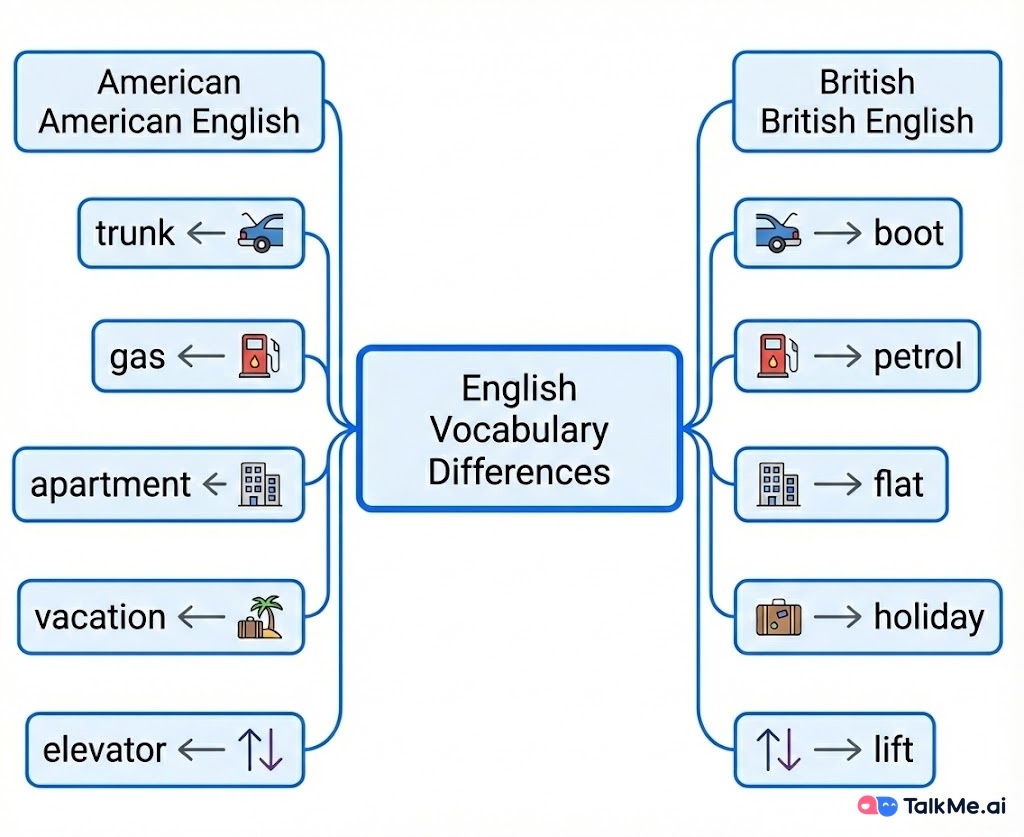
Quick comparison chart
This section works well as a visual summary.
Practical tips and common mistakes
Tips
Pick one variety and stay consistent.
Listen to one main accent daily.
Keep a personal vocabulary notebook.
Practice speaking regularly with feedback.
Using an AI conversation app like TalkMe is useful because you can select a speaking style and practice the same variety every day in realistic situations.
Common mistakes
Switching spelling depending on mood.
Copying phrases from movies without noticing the variety.
Mixing grammar patterns in one sentence.
Thinking it doesn’t matter at all (it does in formal contexts).
FAQ
Is it wrong to mix British and American English?
Not always. People will still understand you. But in formal writing, exams, or professional settings, consistency looks more natural and polished.
Which one is easier to learn?
Neither is objectively easier. American English is more common in global media, while British English is often used in international exams like IELTS.
Do native speakers ever mix the two?
Yes, especially people who travel or consume international media. But they usually stick to one variety in formal contexts.
How can I practice one style every day?
Use consistent learning materials, and practice speaking with tools like TalkMe, where you can simulate real conversations and focus on one accent or vocabulary style.
Key takeaways
Mixing English varieties is very common among learners.
The main differences appear in vocabulary, spelling, grammar, and pronunciation.
Choosing one consistent style improves clarity and confidence.
Regular speaking practice is the fastest way to fix mixing habits.
If you want a simple way to practice consistent English every day, download TalkMe from the App Store or Google Play. You can talk with a lifelike AI tutor, choose your preferred English style, and build natural speaking habits through real-life scenarios.




Comments
No comments yet.
Leave a Comment