

If you listen closely to everyday conversations, you’ll notice how often people rely on simple fillers like “yes,” “no,” and “okay.” While these words are useful, using them too frequently can make your speech sound repetitive, vague, or even disinterested. For language learners, this habit can limit vocabulary growth and make conversations feel less natural.
The good news: with a few simple changes, you can sound more expressive, confident, and fluent.
Why simple replies become a problem
Short responses like “yes,” “no,” and “okay” are comfortable. They require almost no thinking, so learners often use them as a safety net. But over time, this creates several issues:
Limited vocabulary growth: You keep repeating the same few words.
Flat emotional tone: Your speech sounds neutral or robotic.
Miscommunication: “Okay” can mean agreement, understanding, or indifference.
Weak conversational presence: You don’t add information or keep the conversation moving.
For example:
“Do you like the movie?”
“Yes.” → ends the conversation
“Yes, I loved the soundtrack.” → keeps it going
Where the habit usually starts
Most learners pick up this pattern in early language study. Beginners are taught simple, safe responses to avoid mistakes. Over time, these answers become automatic.
Common situations where overuse happens:
In small talk with strangers
During class discussions
At work meetings
When you’re unsure about vocabulary
When you want to respond quickly
The problem isn’t the words themselves—it’s relying on them as your default response.
How to sound more natural: a step-by-step guide
Step 1: Add one extra word
Instead of a single-word reply, attach a short phrase.
“Yes” → “Yes, definitely.”
“No” → “No, not really.”
“Okay” → “Okay, I understand.”
Step 2: Show emotion
Choose words that reflect your real reaction.
“Yes” → “That sounds great!”
“No” → “I’m afraid I can’t.”
“Okay” → “Alright, that works for me.”
Step 3: Give a short reason
A simple explanation makes your speech more natural.
“Yes, I finished it this morning.”
“No, I’ve never tried that before.”
“Okay, I’ll send it after lunch.”
Step 4: Ask a follow-up question
This keeps the conversation alive.
“Yes, I like it. What about you?”
“No, I haven’t been there. Is it good?”
“Okay, when should we start?”
Step 5: Practice with real scenarios
The fastest way to break the habit is through repeated conversation practice. Tools like TalkMe, an AI language tutor that simulates real-life dialogues, can help you rehearse natural responses in everyday situations instead of relying on default words.
Quick reference chart: better alternatives
Practical tips and common mistakes
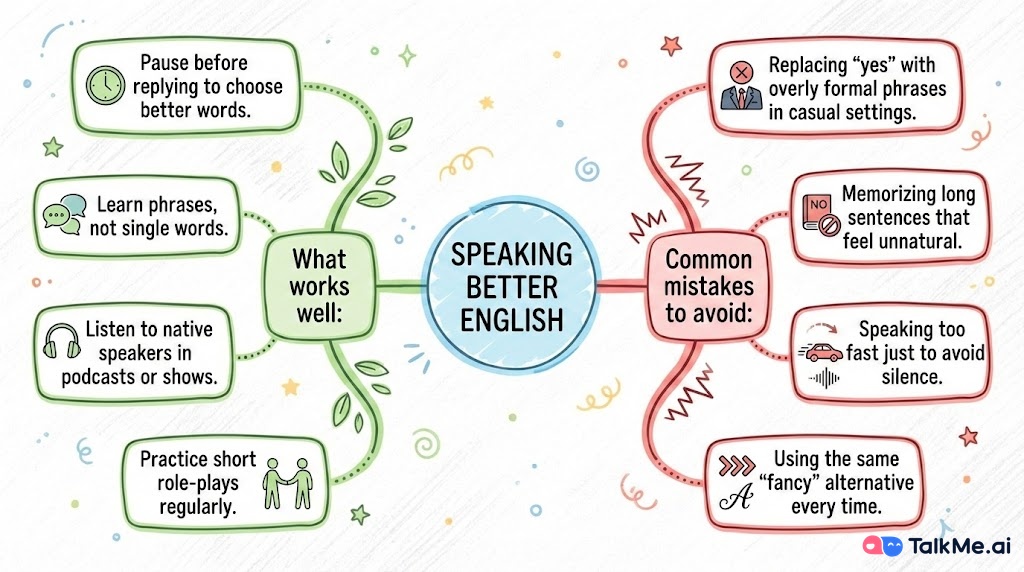
What works well
Pause before replying to choose better words.
Learn phrases, not single words.
Listen to native speakers in podcasts or shows.
Practice short role-plays regularly.
Common mistakes to avoid
Replacing “yes” with overly formal phrases in casual settings.
Memorizing long sentences that feel unnatural.
Speaking too fast just to avoid silence.
Using the same “fancy” alternative every time.
Consistency matters more than complexity.
FAQ
Is it wrong to say “yes,” “no,” or “okay”?
Not at all. These are essential words. The goal is simply to avoid using them as your only response.
How many alternatives should I learn?
Start with 5–10 natural phrases. Use them often until they feel automatic.
What’s the fastest way to break the habit?
Regular speaking practice. Short daily conversations—especially with interactive tools like TalkMe—help replace automatic answers with more natural expressions.
Will this really improve fluency?
Yes. Adding detail and emotion to your responses makes conversations smoother and more engaging.
Key takeaways
Overusing simple replies can make speech sound flat and repetitive.
Small changes—like adding a reason or emotion—make a big difference.
Practice real conversations to build natural response habits.
Focus on phrases, not just single words.
If you want to practice natural responses every day, download TalkMe from the App Store or Google Play. Search for TalkMe, start a quick role-play, and build the habit of speaking with more confidence and variety.




Comments
No comments yet.
Leave a Comment